
Maria Sæther has worked on salmon farms along Norway’s coast for fifteen years. She remembers the early mornings when storms would cancel boat trips to check on the fish, leaving workers helpless on shore while waves battered the fragile nets. “You’d watch the weather forecast like your life depended on it,” she recalls. “Bad weather meant no work, stressed fish, and sleepless nights wondering if the nets would hold.”
Those worries feel like ancient history now. Maria works aboard Havfarm, a massive steel structure that looks more like a warship than a fish farm. When storms rage across the Norwegian Sea, she simply walks along covered walkways, completely protected from the elements.
This isn’t just a story about one worker’s improved conditions. It’s about a revolutionary offshore salmon farm that’s quietly changing how we think about feeding the world’s growing appetite for fish.
Meet the Steel Giant That’s Not Actually a Ship
From five kilometers away, Havfarm looks like it could transport cargo across the Atlantic. At 385 meters long and 60 meters wide, it dwarfs most cruise ships. But this steel colossus never moves from its position off Norway’s Hadseløya island.
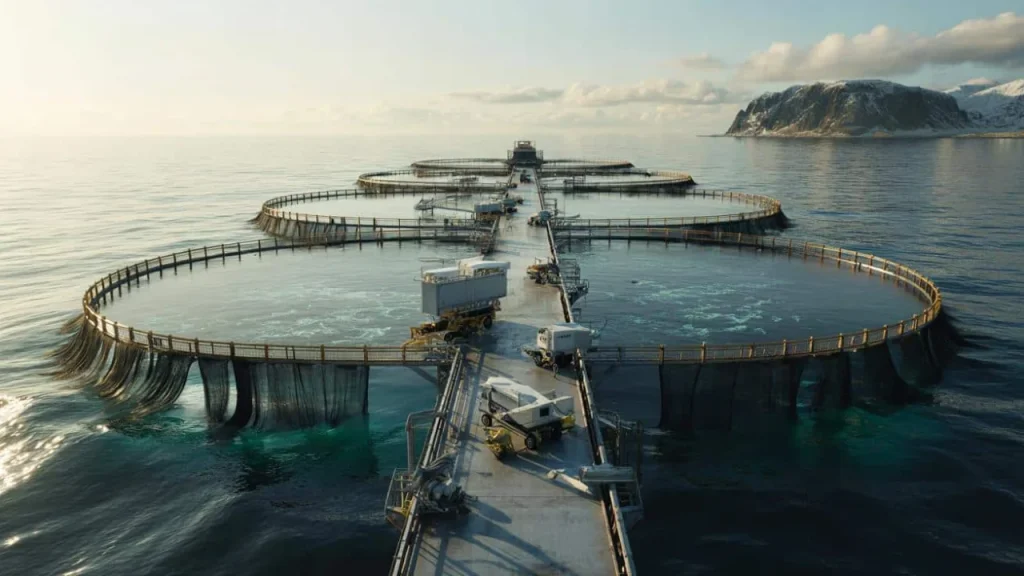
Instead of carrying containers or passengers, Havfarm houses thousands of Atlantic salmon in six circular pens, each measuring 50 meters across. The entire structure sits partially submerged, with more than 30 meters extending below the surface.
“When people first see it, they assume it’s a ship that’s somehow gotten lost,” explains Lars Nordahl, project manager at Nordlaks, the company behind this offshore salmon farm. “But this platform was designed specifically for one purpose: raising fish in the open ocean.”
Traditional salmon farms use plastic nets anchored close to shore in protected fjords. Havfarm takes the opposite approach. Built like a hybrid between an oil rig and a giant catamaran, it’s engineered to handle the roughest conditions the North Atlantic can deliver.

Inside the World’s Most Advanced Fish Farm
The engineering behind this offshore salmon farm reads like science fiction, but every detail serves a practical purpose. Here’s how Havfarm actually works:
- Semi-submersible design keeps the platform stable even in 20-meter waves
- Automated trolley system runs on rails above the fish pens
- Subsea power cables eliminate the need for diesel generators
- Self-monitoring sensors track water quality, fish behavior, and feeding patterns
- Specialized “wellboat” vessels transport fish and supplies to and from shore

The real innovation lies in the automation. Traditional farms require workers to take small boats out to the nets multiple times daily. On Havfarm, automated trolleys glide along steel rails, delivering feed directly to each pen while cameras monitor every corner of the facility.
| Feature | Traditional Farms | Havfarm |
|---|---|---|
| Length | 100-200m plastic nets | 385m steel platform |
| Location | Protected fjords | Open ocean, 5km offshore |
| Power Source | Diesel generators | Subsea cables from land |
| Capacity | 1,000-5,000 fish per pen | 30,000+ fish across 6 pens |
| Weather Resistance | Limited to calm conditions | Operates in all weather |
“The difference is like comparing a small fishing boat to a naval destroyer,” notes Dr. Anne Kristin Øiestad, a marine biologist who has studied both traditional and offshore salmon farming. “One struggles in rough seas, while the other is built to handle them.”
Why Moving Fish Farms to Open Water Changes Everything
The shift from protected fjords to open ocean isn’t just about bigger platforms. It’s about solving problems that have plagued salmon farming for decades.
Near-shore farms often struggle with poor water circulation, leading to waste buildup and disease outbreaks. The stronger currents around Havfarm constantly flush away waste and bring in fresh, oxygen-rich water.
Environmental concerns also drive the move offshore. Traditional farms in fjords can impact local ecosystems and conflict with other uses like fishing and tourism. Moving operations five kilometers out to sea reduces these conflicts while providing salmon with more natural conditions.
“Fish in open water behave more naturally,” explains Øiestad. “They swim more, stress less, and show fewer signs of the behavioral problems we see in confined coastal pens.”
The economic benefits extend beyond healthier fish. Automation reduces labor costs, while the platform’s size allows for economies of scale impossible with traditional net-pen systems.
What This Means for Your Dinner Plate
Norway produces about half the world’s farmed salmon, and innovations like Havfarm could reshape the entire industry. If this offshore salmon farm proves successful, similar facilities could appear off coasts worldwide.
For consumers, this could mean more consistent salmon availability and potentially lower prices as production scales up. The improved conditions may also result in higher-quality fish with better nutritional profiles.
“We’re not just changing how we farm salmon,” says Nordahl. “We’re proving that sustainable aquaculture can work on an industrial scale without harming the environment.”
The platform’s success could also influence other types of offshore farming, from shellfish to seaweed cultivation. Several countries, including the United States and Chile, are already studying Norway’s model for their own coastal waters.
However, challenges remain. The initial investment for offshore salmon farms runs into hundreds of millions of dollars, far exceeding traditional setups. Weather-related delays can still impact operations, even with the platform’s robust design.
Regulatory frameworks also need updating. Most fishing and aquaculture laws were written for near-shore operations and don’t adequately address massive offshore installations like Havfarm.
The Future Floating on Norwegian Waters
Havfarm represents more than technological advancement. It signals a fundamental shift in how humanity approaches ocean farming. As coastal areas become more crowded and environmental pressures increase, moving agriculture offshore offers a path toward sustainable growth.
The platform has already proven it can survive Arctic storms and produce healthy salmon. Now the question becomes whether other companies will follow Nordlaks into the deep water.
“Five years ago, people thought we were crazy,” admits Nordahl. “Now they’re asking how quickly we can build more.”
FAQs
How much does Havfarm cost to build and operate?
The initial construction cost approximately $200 million, but operational savings from automation and scale help offset the investment over time.
Is the salmon from offshore farms different from traditional farmed salmon?
Fish raised in open water tend to be more muscular and show less stress, potentially resulting in better texture and nutritional content.
How does Havfarm handle severe storms?
The semi-submersible design allows the platform to partially sink during storms, reducing wave impact while keeping operations running.
Can workers live on the platform?
Yes, Havfarm includes living quarters for essential staff, though most workers commute daily via specialized boats.
What happens if something goes wrong far from shore?
The platform has backup systems for all critical functions, plus helicopter landing pads for emergency evacuations.
Will offshore farms replace traditional salmon farming?
Not entirely, but they offer a solution for areas where coastal farming faces environmental or space limitations.