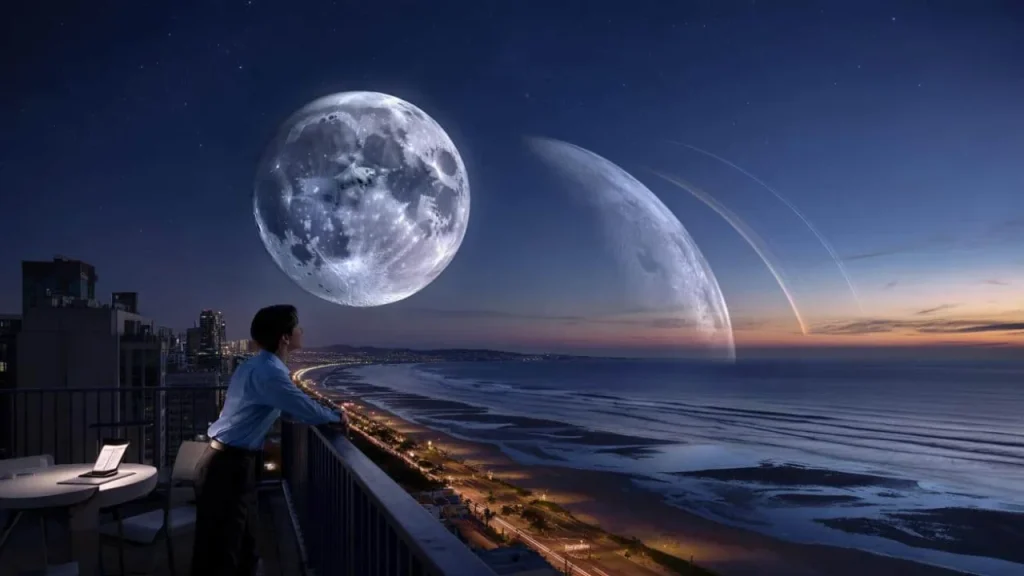

Last Tuesday evening, Sarah Chen stepped onto her apartment balcony in downtown Portland, coffee mug in hand. The city noise had finally died down, and there it was—the Moon, hanging impossibly bright above the skyline. She’d been checking it almost nightly since her astronomy class mentioned something that blew her mind: that silvery disc was actually moving away from Earth, slowly but surely, every single night she looked up at it.

What struck her wasn’t just the fact itself, but how utterly invisible this cosmic dance was to everyone around her. Her neighbors walked by, heads down, scrolling through phones. The Moon looked exactly the same as it did last month, last year, even throughout her entire lifetime. Yet something profound was happening in the space between Earth and that familiar face in the sky.
The Moon is drifting away from our planet at about 3.8 centimeters per year—roughly the length of your thumb—and this seemingly tiny movement is quietly reshaping life on Earth in ways most people never consider.

The invisible cosmic drift that’s changing everything
The moon drifting away from Earth isn’t science fiction or some future concern. It’s happening right now, measurable and real. Scientists have been tracking this lunar recession using laser beams bounced off reflective mirrors that Apollo astronauts left on the Moon’s surface decades ago.
“When we fire those laser pulses and measure the return time, we can detect the Moon moving away from us with incredible precision,” explains Dr. James Williams, a planetary scientist at NASA’s Jet Propulsion Laboratory. “The data shows a consistent pattern that’s been going on for billions of years.”
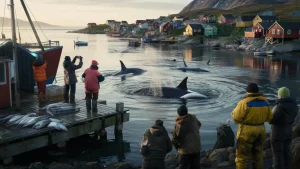
This gradual separation occurs because of tidal forces. As Earth’s oceans bulge toward the Moon, creating our familiar tides, friction between moving seawater and the ocean floor acts like a cosmic brake on our planet’s rotation. The energy from Earth’s slowing spin gets transferred to the Moon’s orbit, gradually pushing it farther away.
The process is so slow that in a human lifetime, the Moon moves away by roughly the length of a small car. But over geological time, this adds up to dramatic changes.

How our days are secretly getting longer
Here’s where things get fascinating for everyone living on this planet: as the Moon drifts away, our days are actually getting longer. Not by amounts you’d notice—we’re talking about 1.7 milliseconds per century. But the cumulative effect over Earth’s history has been enormous.
Geologists can read this story in ancient rocks and fossilized coral reefs. These natural time capsules show that 4 billion years ago, Earth days were only about 6 hours long. When dinosaurs roamed the planet 100 million years ago, a day lasted roughly 23 hours.

| Time Period | Day Length | Moon Distance |
|---|---|---|
| 4 billion years ago | ~6 hours | Much closer to Earth |
| 100 million years ago | ~23 hours | Closer than today |
| Today | 24 hours | 384,400 km away |
| 50 million years future | ~25 hours | Farther from Earth |
“The Moon has been our planet’s natural timekeeper, gradually slowing us down for billions of years,” notes Dr. Rebecca Morrison, a geophysicist at Stanford University. “Without the Moon, Earth would be spinning much faster, and life as we know it might never have developed.”
The mechanism behind this is surprisingly simple: tidal friction. Every time the ocean tides rise and fall, energy gets dissipated through friction with the seafloor and coastlines. This energy has to come from somewhere—and it comes from Earth’s rotational energy, gradually slowing our planet’s spin.
The changing face of Earth’s tides
As the moon drifting away continues, Earth’s tides are becoming progressively weaker. The gravitational pull that creates our twice-daily tidal cycles is inversely related to distance—the farther the Moon gets, the gentler its tidal influence becomes.
This has real implications for coastal ecosystems and human activities:
- Tidal ranges in coastal areas are slowly decreasing over geological time
- Tidal energy generation becomes slightly less efficient over millions of years
- Marine ecosystems that depend on strong tidal cycles face gradual changes
- Coastal erosion patterns shift as tidal forces weaken
“Fishermen won’t notice this in their lifetime, but over tens of thousands of years, tidal patterns that have remained consistent throughout human history will start to shift,” explains Dr. Thomas Chen, a marine geologist at Woods Hole Oceanographic Institution.
The Moon’s gravitational influence also affects Earth’s axial tilt, which determines our seasons. As the lunar distance increases, the Moon becomes less effective at stabilizing Earth’s axis, potentially leading to more variable climate patterns over very long timescales.
What this means for the far future
Looking ahead millions of years, the moon drifting away will fundamentally alter Earth’s relationship with its satellite. Eventually, the Moon will become tidally locked to Earth in a different way—both bodies will show the same face to each other permanently, with days and months becoming equal in length.
But there’s a twist in this cosmic story. While the Moon is currently moving away from Earth, this process won’t continue forever. In about 15 billion years, the Sun will have aged and changed enough that the dynamics of the Earth-Moon system will reverse.
“Eventually, solar tidal forces will start dominating, and the Moon might actually begin spiraling back toward Earth,” notes Dr. Morrison. “But that’s so far in the future that the Sun will likely have evolved into a different type of star by then.”
For now, though, we’re living through a unique period in Earth’s history. The Moon is at just the right distance to create total solar eclipses—a cosmic coincidence that won’t last forever. As the Moon continues its slow retreat, total solar eclipses will become impossible, replaced only by partial eclipses.
The next time you look up at the Moon, remember: you’re witnessing a moment in a 4.5-billion-year dance between two celestial bodies. The Moon that inspired countless poets and guided ancient navigators is slowly, inevitably, saying goodbye. But that goodbye is taking so long that a thousand human lifetimes won’t see any noticeable change in its gentle, familiar glow.
FAQs
How fast is the Moon moving away from Earth?
The Moon drifts away at about 3.8 centimeters (1.5 inches) per year, roughly the rate at which your fingernails grow.
Will the Moon eventually leave Earth’s orbit completely?
No, the Moon will never escape Earth’s gravity. It will eventually become tidally locked in a stable orbit much farther away than today.
Can we feel the effects of longer days?
Not at all. Days are lengthening by only 1.7 milliseconds per century, which is far too small for humans to perceive.
How do scientists measure the Moon’s distance so precisely?
They use laser ranging experiments, bouncing laser beams off reflective mirrors that Apollo astronauts placed on the Moon’s surface.
Did the Moon affect how life evolved on Earth?
Yes, the Moon’s influence on tides and Earth’s rotation likely played a crucial role in creating stable conditions that allowed complex life to develop.
Will this affect future space missions to the Moon?
The change is so gradual that it won’t impact any missions planned for the next several centuries. The Moon’s position remains predictable over human timescales.