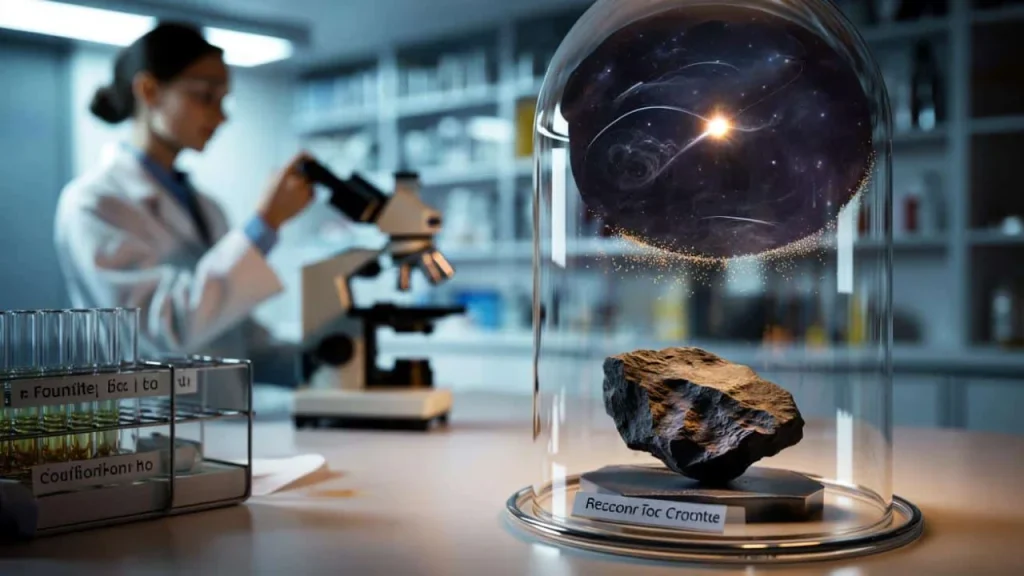

Picture this: you’re walking through your neighborhood when you spot what looks like an ordinary rock on the sidewalk. You might kick it aside without a second thought. But what if that humble stone contained fragments older than the Sun itself—microscopic treasures that witnessed the birth of stars billions of years before our planet even existed?

That’s exactly what happened in the Sahara Desert, where what appeared to be scattered pebbles turned out to be one of the most remarkable scientific discoveries of recent years. This isn’t just another space rock story. It’s about holding pieces of the universe’s ancient history in your hands.
The meteorite grains older than our Solar System are rewriting what we know about cosmic evolution, and they’re sitting in a French laboratory right now, revealing secrets that could change our understanding of how worlds are born.

When Desert Rocks Become Cosmic Treasures
In 2018, meteorite hunter Jean Redelsperger was combing through the Western Sahara near a small village called Haouza. The area, known locally as Chwichiya, is littered with stones—most of them entirely ordinary. But Redelsperger’s trained eye spotted something different about a handful of dark fragments scattered across the desert floor.
These weren’t your typical rocks. They bore the telltale signs of a meteorite: a dark, glassy fusion crust formed when the object blazed through Earth’s atmosphere. What Redelsperger didn’t know at the time was that he’d stumbled upon one of the most primitive objects ever to land on our planet.

The meteorite, now officially designated Chwichiya 002, belongs to an exceptionally rare class of carbon-rich space rocks called carbonaceous chondrites. But this one is special—it contains microscopic grains that formed in the hearts of dying stars billions of years before our Sun was even born.
“These presolar grains are literally stardust—the ashes of ancient stars that lived and died long before our Solar System existed,” explains Dr. Marie Petitjean, a cosmochemist at the French National Museum of Natural History.

The Science Behind These Ancient Cosmic Relics
When scientists at France’s Centre de Recherche et d’Enseignement Multidisciplinaire en Environnement (CEREGE) began analyzing Chwichiya 002, they realized they were dealing with something extraordinary. The meteorite is classified as a C3.00 “ungrouped” carbonaceous chondrite—scientific jargon that basically means it’s incredibly primitive and doesn’t fit neatly into existing categories.
Here’s what makes these meteorite grains older than the Sun so remarkable:

- They’ve remained virtually unchanged for over 4.6 billion years
- They contain presolar grains formed in dying stars before our Solar System existed
- The parent asteroid experienced minimal heating or water alteration
- They preserve the original composition of the solar nebula
- They offer direct samples of interstellar dust clouds
The technical details tell an amazing story. Chwichiya 002 shows a classification of C3.00, where the number indicates how little thermal alteration it has experienced. Most meteorites show some signs of heating or chemical changes, but this one is essentially frozen in time.
| Meteorite Feature | Chwichiya 002 | Typical Meteorites |
|---|---|---|
| Thermal Alteration | Virtually none (3.00) | Moderate to high |
| Water Alteration | Minimal | Often significant |
| Presolar Grain Content | Exceptionally high | Usually very low |
| Age of Components | Up to 7 billion years | 4.6 billion years |
| Preservation State | Pristine | Often modified |
“What we’re looking at is essentially unchanged material from the birth of the Solar System, with bonus components that are even older,” notes Dr. Jérôme Gattacceca, who led the initial analysis at CEREGE.
Why These Ancient Grains Matter to All of Us
You might wonder why microscopic grains in a meteorite should matter to anyone outside the scientific community. The answer lies in what these cosmic relics can teach us about our origins.
These meteorite grains older than the Sun are like reading the universe’s diary from before Earth existed. They tell us about the stellar processes that created the elements we’re made of—the carbon in our bodies, the oxygen we breathe, the iron in our blood.
The presolar grains in Chwichiya 002 formed in the nuclear furnaces of massive stars that lived fast and died young, exploding as supernovae and seeding space with heavy elements. Without these ancient stellar deaths, planets like Earth couldn’t exist, and neither could we.
Scientists are using advanced techniques to study individual grains smaller than a human hair. They’re measuring isotopic ratios that reveal which types of stars created specific elements, how long materials spent floating through space, and what conditions were like in the early Solar System.
“Each grain is like a microscopic fossil of stellar evolution,” explains Dr. Petitjean. “They’re teaching us about stellar nucleosynthesis, galactic chemical evolution, and the processes that led to planets capable of supporting life.”
The Hunt for More Cosmic Treasures
Chwichiya 002 isn’t just sitting in a display case. French researchers are actively studying every fragment, using techniques like scanning electron microscopy and ion microprobes to map its composition grain by grain.
The meteorite’s discovery has also sparked renewed interest in hunting for similar specimens. The Sahara Desert, with its dry climate and dark rocks standing out against light sand, has become a hotspot for meteorite recovery. But finding samples this primitive is like winning the cosmic lottery.
Most carbonaceous chondrites have been altered by heat, water, or cosmic radiation during their billions of years in space. Chwichiya 002’s exceptional preservation suggests its parent asteroid avoided most of these processes, possibly by orbiting in a particularly cold, stable region of the early Solar System.
“We estimate that fewer than one in ten thousand meteorites are this well-preserved,” says Dr. Gattacceca. “Finding one with such a high concentration of presolar material is even rarer.”
What Comes Next in This Cosmic Detective Story
The research into Chwichiya 002 is just beginning. Scientists plan to extract and analyze individual presolar grains to determine their precise ages and stellar origins. Some grains might be 7 billion years old—formed when the universe was less than half its current age.
These studies could help answer fundamental questions about how our galaxy evolved, how often stars like our Sun form, and what conditions are necessary for planetary systems to develop. The meteorite grains older than the Sun serve as witnesses to cosmic events we can study in no other way.
French institutions are also working to preserve and catalog the meteorite properly. Parts of the specimen are being distributed to research laboratories worldwide, ensuring that multiple teams can contribute to unlocking its secrets.
The discovery reminds us that sometimes the most profound scientific insights come from the most unexpected places. A few unremarkable stones in the desert have opened a window into the deep past of our universe, proving that cosmic treasures can be found in the most ordinary-looking packages.
FAQs
How old are the grains in this meteorite compared to the Sun?
The presolar grains in Chwichiya 002 are up to 7 billion years old, while our Sun formed about 4.6 billion years ago. These grains predate our entire Solar System by billions of years.
How do scientists know these grains are older than the Sun?
Researchers measure isotopic ratios in the grains that are impossible to produce in our Solar System. These unique signatures match theoretical predictions for material formed in ancient stars with different nuclear processes.
Are meteorites with presolar grains dangerous to handle?
Not at all. These meteorites are completely safe and contain no harmful radiation. The ancient grains are studied using sophisticated laboratory equipment, but the meteorite itself poses no danger.
How much is a meteorite like Chwichiya 002 worth?
Scientifically priceless, but meteorites of this rarity can command thousands of dollars per gram on the collector market. However, most specimens end up in research institutions rather than private collections.
Could there be more meteorites like this one waiting to be found?
Absolutely. The Sahara Desert likely contains many more pristine meteorites, but finding ones this well-preserved requires both luck and expertise. Climate change and human activity are making such discoveries increasingly urgent.
What makes French researchers particularly interested in this meteorite?
France has world-leading expertise in meteorite classification and presolar grain analysis. French institutions like CEREGE and the National Museum of Natural History are at the forefront of studying these ancient cosmic materials.