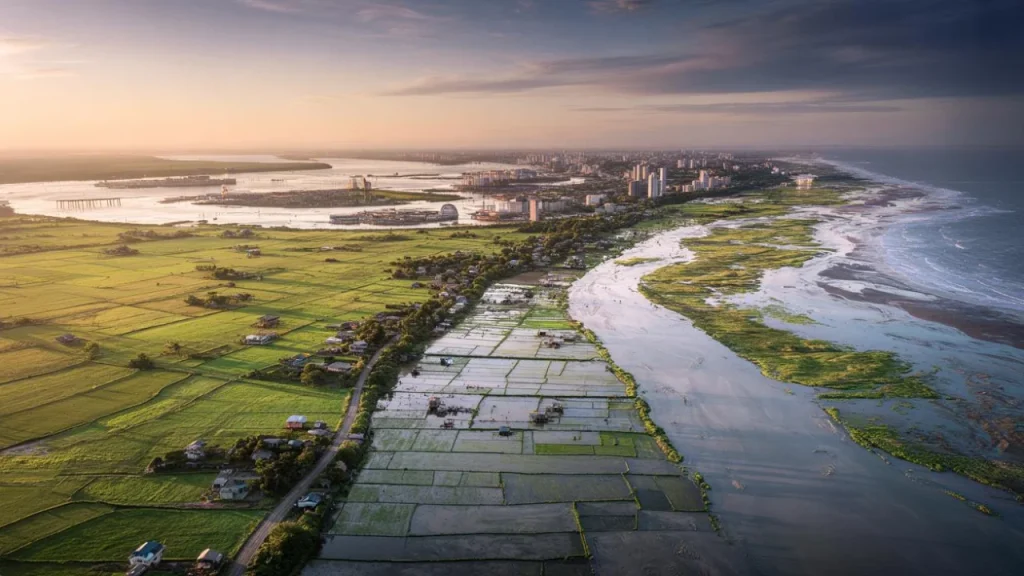

Maria Nguyen still remembers the day her family’s rice farm in the Mekong Delta went underwater for the first time. It wasn’t during monsoon season, and there hadn’t been a major storm. Just a regular high tide that somehow crept further inland than ever before, turning her grandmother’s vegetable garden into a muddy lake.

“My grandmother kept saying the water had never come this far before,” Maria recalls. “She’d lived there for 80 years and had never seen anything like it.” What Maria’s family didn’t realize was that their land wasn’t just being invaded by rising seas – it was literally sinking beneath their feet.
This story is playing out across the globe’s most densely populated coastal regions, where land subsidence is quietly reshaping entire landscapes faster than climate change alone ever could.

The Hidden Crisis Beneath Our Feet
While the world focuses on rising sea levels, a more immediate threat lurks beneath major river deltas and coastal cities. Land subsidence – the gradual sinking of ground surface – is accelerating at an alarming pace, outstripping ocean rise by orders of magnitude in some regions.
From Vietnam’s Mekong Delta to Louisiana’s Mississippi River Delta, from Indonesia’s Jakarta to Bangladesh’s Ganges-Brahmaputra Delta, the ground is dropping by centimeters each year. Meanwhile, global sea levels creep up by just a few millimeters annually.
“We’re seeing subsidence rates of 5 to 15 centimeters per year in some areas, which is absolutely staggering when you compare it to the 3.4 millimeters of annual sea level rise,” explains Dr. Sarah Chen, a coastal geologist who has studied subsidence patterns across Southeast Asia.
This dramatic difference means that in many vulnerable coastal regions, the primary flood risk comes not from above, but from below – as communities literally sink closer to sea level with each passing year.

The Science Behind the Sinking
River deltas are naturally unstable landscapes, built from layers of sediment deposited over thousands of years. Some natural settling is expected as these soft materials compact under their own weight. But current subsidence rates far exceed anything that natural processes could explain.
The main driver behind accelerated land subsidence is groundwater extraction. As cities grow and agriculture expands, communities pump water from underground aquifers faster than nature can replenish them.

Here’s how the process works:
- Underground water fills spaces between soil particles
- When water is pumped out, these spaces collapse
- Soil layers compress and compact together
- The ground surface drops permanently
- Refilling aquifers cannot reverse the damage
Additional factors contributing to subsidence include:
- Reduced sediment flow from upstream dams
- Urban development adding weight to soft soils
- Oil and gas extraction in some regions
- Natural oxidation of organic-rich delta soils
| Region | Average Subsidence Rate (cm/year) | Primary Cause |
|---|---|---|
| Mekong Delta, Vietnam | 5-8 | Groundwater pumping |
| Jakarta, Indonesia | 10-25 | Groundwater extraction |
| Mississippi Delta, USA | 3-7 | Sediment compaction |
| Nile Delta, Egypt | 2-5 | Reduced sediment flow |
| Po Delta, Italy | 1-4 | Gas extraction, pumping |
Communities Living on Borrowed Time
The human impact of land subsidence extends far beyond flooding. Entire ways of life are disappearing as communities adapt to their changing landscape.
In Ho Chi Minh City, Vietnam’s economic hub built partly on Mekong Delta sediments, residents have watched their neighborhoods transform. Buildings develop cracks as foundations shift. Roads buckle and require constant repair. Drainage systems fail as pipes break under the stress of settling ground.
“Every year, we have to raise our house a little higher,” says Tran Van Duc, a resident of the city’s District 2. “My neighbors and I, we all know what’s happening, but what choice do we have?”
Agricultural communities face even starker choices. Rice farmers across the Mekong Delta report that saltwater now penetrates further inland during dry seasons, contaminating freshwater supplies and destroying crops. What used to be productive farmland becomes brackish marsh, forcing families to abandon traditional livelihoods.
The economic consequences ripple outward. Infrastructure built for stable ground requires constant maintenance and eventual relocation. Port facilities sink below optimal operating levels. Airport runways crack and flood. Entire neighborhoods become uninhabitable.
The Race Against Time
Unlike sea level rise, which offers decades for adaptation, land subsidence creates immediate, irreversible changes. Once soil compacts, the damage is permanent on human timescales.
“The scary thing about subsidence is that once it starts accelerating, you can’t undo it,” warns Dr. Michael Rodriguez, who studies coastal vulnerability at the University of California. “You can slow it down by reducing groundwater pumping, but the land that’s already sunk is gone forever.”
Some regions are attempting interventions:
- Restricting groundwater extraction through regulations
- Investing in alternative water sources like desalination
- Building sea walls and flood barriers
- Relocating vulnerable communities to higher ground
- Developing floating agriculture systems
However, these solutions require massive investment and political will that many affected regions lack. Jakarta, which faces some of the world’s fastest subsidence rates, has announced plans to move the capital to higher ground – a dramatic acknowledgment that the current location may be unsalvageable.
Looking Forward: A Sinking World
Climate scientists predict that by 2050, land subsidence combined with sea level rise could displace over 100 million people globally. The phenomenon affects not just developing countries but also wealthy regions like California’s Central Valley and parts of Texas.
“We’re essentially creating a two-pronged attack on our coastal communities,” explains Dr. Jennifer Walsh, a hydrologist studying subsidence patterns. “The sea rises from below while the land sinks from above. The result is flooding that happens faster and reaches further than either factor would cause alone.”
Early warning systems and improved monitoring can help communities prepare, but ultimately, addressing land subsidence requires fundamental changes in how we manage water resources and develop coastal areas.
The stories of families like Maria Nguyen’s remind us that behind every centimeter of subsidence are real people watching their worlds slowly disappear. As the ground beneath our most populous regions continues to sink, the race is on to find solutions before entire landscapes slip beneath the waves.
FAQs
What is land subsidence and how fast does it happen?
Land subsidence is the gradual sinking of ground surface, typically caused by groundwater pumping or soil compaction. It can occur at rates of 1-25 centimeters per year in affected areas.
Which regions are most affected by land subsidence?
Major river deltas like the Mekong, Mississippi, and Nile deltas face severe subsidence, along with cities like Jakarta, Ho Chi Minh City, and parts of California’s Central Valley.
Can land subsidence be reversed or stopped?
Subsidence can be slowed by reducing groundwater pumping, but the damage is largely irreversible. Once soil compacts, refilling aquifers won’t restore the original ground level.
How does land subsidence differ from sea level rise?
Sea level rise occurs gradually at millimeters per year globally, while land subsidence can happen much faster in localized areas, often at centimeters per year.
What can communities do to adapt to land subsidence?
Adaptation strategies include restricting groundwater use, building flood defenses, developing alternative water sources, and in extreme cases, relocating to higher ground.
Is land subsidence related to climate change?
While climate change drives sea level rise, land subsidence is primarily caused by human activities like groundwater pumping, though both factors combine to increase flood risks.