
María walks her dog every morning through the cobblestone streets of Lisbon, passing the same ancient buildings her grandmother once knew. The ground feels solid beneath her feet, just as it always has. What she doesn’t realize is that the entire country is slowly spinning beneath her — so gradually that in her lifetime, her great-grandchildren’s lifetime, and dozens of generations beyond, no human will ever notice the movement.

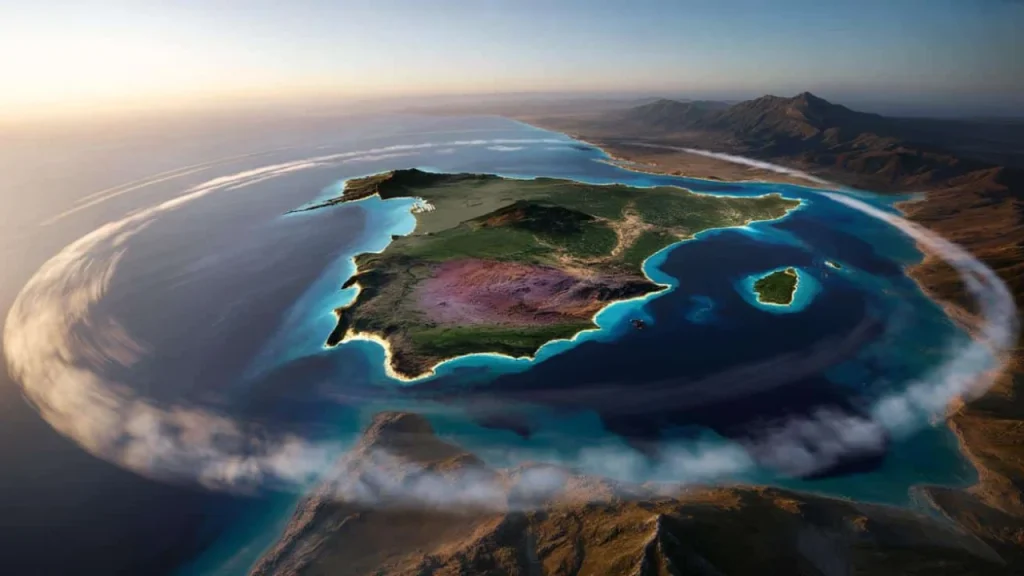
This isn’t science fiction. According to new geological research, the entire Iberian Peninsula — home to both Spain and Portugal — is rotating clockwise like a massive stone wheel, driven by the relentless collision between African and European tectonic plates.
The discovery challenges everything we thought we knew about how this corner of Europe behaves, and it could completely change how scientists predict earthquakes in a region where millions of people live.
The Earth’s Secret Dance Beneath Our Feet
For generations, geology textbooks painted a simple picture: tectonic plates slide past each other like giant conveyor belts. One plate pushes north, another dives downward, and earthquakes happen along clean, predictable fault lines.
The Iberian Peninsula rotation throws that neat explanation out the window.

In a groundbreaking study published in Gondwana Research, geologists discovered that Spain and Portugal aren’t just drifting northward with the rest of the Eurasian plate. Instead, the entire landmass is executing a slow, clockwise spin that’s been going on for millions of years.
“The Iberian Peninsula is experiencing a slow clockwise spin, generated by uneven forces from the colliding African and Eurasian plates,” explains lead researcher Dr. Asier Madarieta.
The rotation happens at a pace that makes glaciers look speedy. Africa and Europe creep toward each other at roughly 4 to 6 millimeters per year — about the same rate your fingernails grow. But instead of creating a simple northward push, this continental collision creates a twisting motion across southern Spain, Portugal, and the surrounding seafloor.
Why This Corner of Europe Refuses to Follow the Rules
Most plate boundaries are relatively tidy affairs. Picture the San Andreas Fault in California — a clear line where two plates slide past each other. Or think of the Mid-Atlantic Ridge, where new ocean floor spreads apart in a neat, organized fashion.

The western Mediterranean laughs at such organization.
South of Iberia, the boundary between African and European plates becomes a geological mess. Instead of one obvious fault zone, stresses spread across a broad area stretching from the Atlantic Ocean, past the Strait of Gibraltar, and into the western Mediterranean Sea.
Here’s what makes the Iberian Peninsula rotation so unique:
- Multiple small fault systems instead of one major boundary
- Uneven pressure from different directions creating rotational forces
- Complex interactions between oceanic and continental crust
- Varying speeds of movement across different regions
“Uneven compression from the south and sideways push from the Mediterranean create a torque on Iberia rather than a straight-line collision,” notes geophysicist Dr. Carmen Rodriguez, who wasn’t involved in the study but has researched Mediterranean tectonics for over two decades.
Think of it like pushing on different sides of a dinner plate floating in water. Push evenly from one side, and it slides straight. Push unevenly from multiple angles, and it starts to rotate.
The Numbers Behind the Spin
The Iberian Peninsula rotation might be invisible to human perception, but modern GPS technology and geological analysis can measure it with remarkable precision.
| Measurement | Rate/Distance | Time Scale |
|---|---|---|
| Africa-Europe Convergence | 4-6 mm/year | Ongoing |
| Iberian Rotation Speed | 0.2-0.5°/million years | Long-term geological |
| Total Rotation (last 20 million years) | 4-10° | Historical geological |
| Distance moved (Lisbon) | Several kilometers | Over millions of years |
These measurements reveal that different parts of the peninsula move at slightly different rates. The southwestern edge, including much of Portugal, experiences more rotation than the northeastern regions near the Pyrenees mountains.
“What we’re seeing is essentially a giant geological bearing, with Iberia rotating on a complex axis that runs roughly through central Spain,” explains Dr. Jean-Claude Mareschal, a European tectonic specialist.
What This Means for Earthquake Prediction and Safety
The discovery of Iberian Peninsula rotation isn’t just academic curiosity — it has real implications for the 60 million people living in Spain and Portugal.
Traditional earthquake models assumed the region experienced simple north-south compression. If the landmass is actually rotating, stress patterns become far more complex. Fault lines that seemed stable might be under different types of pressure than scientists realized.
The 1755 Lisbon earthquake, which killed tens of thousands and destroyed much of the city, occurred in this rotational zone. While that particular quake happened offshore, the complex stress patterns from Iberian Peninsula rotation could influence where future earthquakes might strike.
Key implications include:
- Revised earthquake hazard maps for southwestern Europe
- Better understanding of why certain areas experience more seismic activity
- Improved building codes for regions under rotational stress
- Enhanced tsunami modeling for Atlantic coastal areas
“We need to completely rethink how we assess seismic risk in this region,” warns Dr. Isabella Santos, a Portuguese seismologist. “A rotating landmass creates stress patterns we’re only beginning to understand.”
The Bigger Picture: Europe’s Restless Foundation
The Iberian Peninsula rotation reveals something profound about how continents actually behave. Rather than rigid blocks grinding past each other, landmasses can bend, twist, and rotate in response to competing forces.
This discovery joins other recent findings showing that supposedly stable continents are more dynamic than previously thought. Parts of eastern Turkey rotate counter-clockwise. Sections of the Anatolian plate spin like a geological top. Even supposedly stable North America shows signs of internal rotation in some regions.
For residents of Spain and Portugal, this knowledge doesn’t change daily life. The rotation happens too slowly for human perception, and the peninsula isn’t going to spin off into the Atlantic anytime soon.
But for scientists trying to understand earthquake risks, plan infrastructure, and predict how the Mediterranean will evolve over geological time, the Iberian Peninsula rotation represents a fundamental shift in thinking.
“We’re learning that the Earth’s crust is far more flexible and dynamic than we ever imagined,” concludes Dr. Madarieta. “What looks solid and permanent to us is actually in constant, subtle motion.”
FAQs
Can people feel the Iberian Peninsula rotating?
No, the rotation happens far too slowly for humans to detect — about 0.2 to 0.5 degrees per million years.
Will Portugal and Spain eventually spin away from Europe?
No, the rotation is small and constrained by surrounding landmasses. The peninsula remains firmly connected to the European continent.
Does this rotation cause earthquakes?
The rotation creates stress patterns that can influence where earthquakes occur, but it’s not a direct cause of individual quakes.
How did scientists discover this rotation?
Researchers used GPS measurements, magnetic field analysis, and geological mapping to track tiny movements over time.
Are other parts of Europe rotating too?
Some regions show similar behavior, particularly around the Mediterranean, but the Iberian Peninsula shows the clearest rotation pattern.
When did this rotation start?
The rotation has likely been ongoing for millions of years, driven by the long-term collision between African and European plates.