
Maria stood in her small apartment in Lisbon, watching her grandmother’s antique compass wobble slightly on the wooden table. “Abuela, why does this old thing never point quite right?” she asked during their weekly video call. Her grandmother, now living in Madrid, chuckled from the screen. “Mija, maybe Portugal is just spinning away from Spain!” It was meant as a joke, but Maria had no idea how close to the truth that lighthearted comment actually was.

What sounds like family banter is actually happening beneath their feet. While Maria goes about her daily life, the ground under Portugal and Spain is engaged in something extraordinary – a slow, almost imperceptible dance that’s been going on for millions of years.
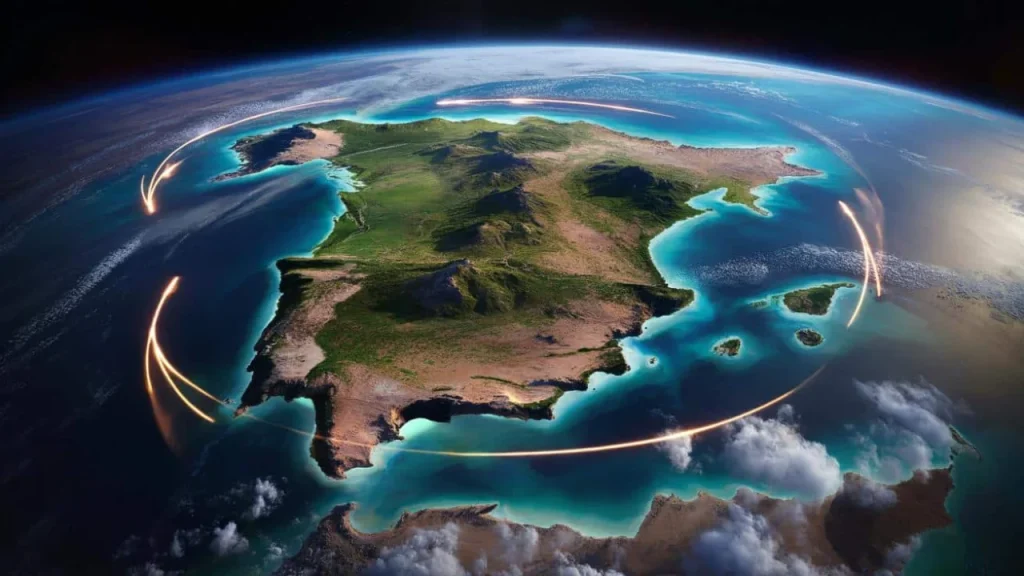
Deep beneath the cobblestone streets of Porto, the flamenco halls of Seville, and the beaches of the Algarve, the entire Iberian Peninsula is slowly rotating clockwise. This isn’t some wild geological theory – it’s a measurable reality that’s reshaping how scientists understand earthquake risks and continental drift in this corner of Europe.

The Peninsula That Refuses to Play by the Rules
Most of us learned in school that continents move like giant puzzle pieces on conveyor belts called tectonic plates. One plate pushes against another, mountains rise, earthquakes happen – simple enough. But the Iberian Peninsula has always been the rebellious student in geology class.
While the rest of Europe drifts steadily with the Eurasian plate, Spain and Portugal are doing their own thing. The African and Eurasian plates are pushing toward each other at about 4 to 6 millimeters per year – slower than your fingernails grow, but relentless.

“This collision isn’t happening along a clean, straight line like we see in other parts of the world,” explains geologist Dr. Asier Madarieta, who has spent years studying this phenomenon. “Instead, we have this complex, messy boundary that creates uneven pressures across the entire peninsula.”
Picture trying to slide a book across your desk while someone pushes against one corner more than the other. The book doesn’t just move straight – it starts to rotate. That’s essentially what’s happening to Iberia on a continental scale.

The Science Behind the Spin
The Iberian Peninsula rotation isn’t just academic curiosity – it’s measurable, ongoing, and has real implications for millions of people. Here’s what researchers have discovered:
| Measurement | Rate | Timeframe |
|---|---|---|
| Clockwise rotation speed | 0.15-0.2 degrees per million years | Ongoing |
| Plate convergence rate | 4-6 millimeters per year | Current |
| Total rotation (estimated) | 35 degrees | Past 20 million years |
The rotation happens because of uneven pressures acting on different parts of the peninsula:

- Southern pressure: The African plate pushes northward against the Mediterranean coast
- Western resistance: The Atlantic oceanic crust provides a relatively stable boundary
- Eastern complexity: The western Mediterranean experiences its own internal deformation
- Northern connection: The Pyrenees create a partial link to stable Europe
“Think of it like a door that’s hinged on one side but free to swing on the other,” says Dr. Carmen Rodriguez, a seismologist at the University of Barcelona. “The western edge of Iberia stays relatively fixed while the eastern side pivots around it.”
This rotation explains some puzzling geological features that have long confused scientists. Ancient rock formations that should align with similar rocks in North Africa are slightly twisted. Earthquake patterns don’t follow the simple north-south compression you’d expect from a head-on collision.
What This Means for Real People
Before you start worrying about your house spinning like a record player, remember that geological time operates on scales that make human civilization look like a brief moment. The rotation is so slow that even sophisticated GPS equipment can barely detect it over decades of measurement.
But the implications are real and important for earthquake preparedness and urban planning:
- Seismic risk patterns: Understanding the rotation helps predict where stress builds up and earthquakes are more likely
- Infrastructure planning: Major bridges, dams, and buildings need to account for long-term ground movement
- Coastal changes: Over very long periods, coastlines will shift as the peninsula continues its slow turn
“We’re not talking about catastrophic changes that will affect anyone alive today or their great-grandchildren,” clarifies Dr. Madarieta. “But for understanding earthquake risks and planning major infrastructure projects, this rotation is crucial information.”
The discovery also helps explain why some parts of the Iberian Peninsula experience more seismic activity than others. Areas where the rotational stress concentrates – particularly in southern Spain and the Gibraltar region – see more frequent earthquakes.
The Bigger Picture of a Moving Earth
The Iberian Peninsula rotation is part of a larger story about how our planet’s surface constantly reshapes itself. While we tend to think of the ground beneath our feet as solid and permanent, Earth’s crust is more like a slow-motion liquid, flowing and twisting over millions of years.
“This research changes how we think about plate boundaries,” explains Dr. Rodriguez. “They’re not always sharp lines on a map. Sometimes they’re broad zones of deformation where entire regions slowly twist and bend.”
Other parts of the world show similar complex behaviors. The Mediterranean region as a whole is a geological puzzle where multiple small plates and fragments interact in complicated ways. The Iberian Peninsula rotation is just one piece of that larger puzzle.
For the people living in Spain and Portugal, this geological dance continues beneath their daily lives. The same forces that built the Pyrenees mountains and created the dramatic coastlines that attract millions of tourists each year are still active, still slowly reshaping the land.
As Maria finally figured out why her grandmother’s compass seemed off, she realized she was part of something much larger – a slow, majestic rotation that connects her tiny apartment in Lisbon to the massive geological forces that shape our planet. The next time she calls her grandmother in Madrid, she’ll have a fascinating story to share about why Portugal really is, in a very literal sense, slowly spinning away from Spain.
FAQs
Is the Iberian Peninsula really spinning like a top?
Not exactly like a top, but yes, it’s rotating clockwise very slowly due to uneven tectonic pressures. The rotation is so gradual that it takes millions of years to complete even a few degrees.
Will this rotation cause major earthquakes?
The rotation itself doesn’t cause earthquakes, but understanding it helps scientists better predict where seismic stress builds up. Areas where rotational forces concentrate do experience more earthquake activity.
Can people feel this movement happening?
No, the movement is far too slow to feel. Even sensitive GPS equipment can barely measure it over decades of monitoring.
How long has this been going on?
Scientists estimate the peninsula has been rotating for at least 20 million years, turning about 35 degrees during that time period.
Will Spain and Portugal eventually separate from Europe?
No, the rotation is happening while the peninsula remains connected to Europe. It’s more like a door slowly swinging on hinges than a complete separation.
Does this affect the border between Spain and Portugal?
The rotation is so slow that it has no practical effect on modern political borders. Any changes would take millions of years to become noticeable.