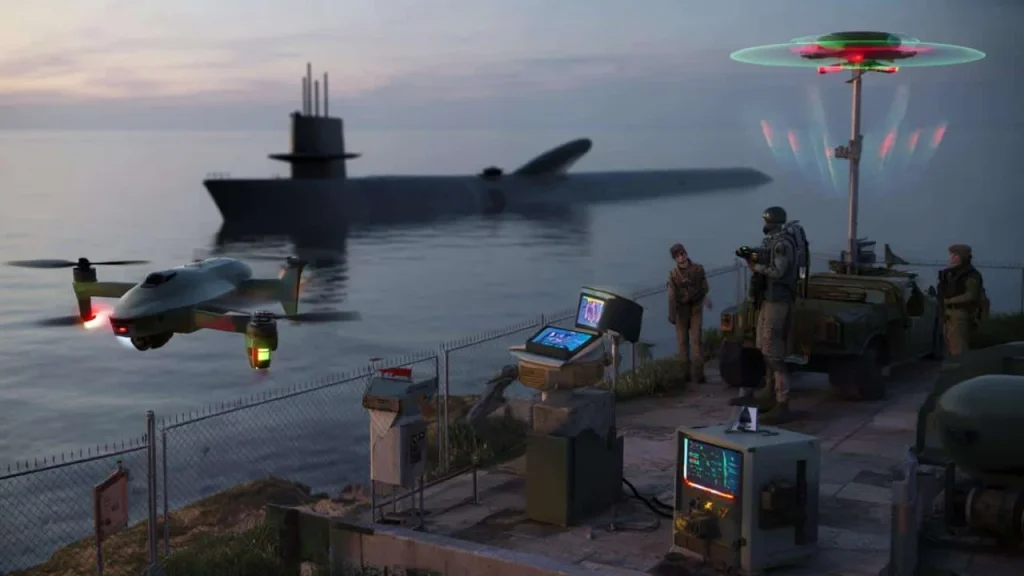

Last Tuesday evening, security guard Michel Dubois was making his usual rounds at a French military facility when something small and silent zipped over his head. By the time he looked up, it was gone—just a dark speck disappearing into the twilight. What he didn’t know was that this tiny intruder had just photographed classified equipment worth millions of euros.

Michel’s experience isn’t unique. Across France, similar encounters are happening almost daily. Guards, soldiers, and facility managers are all reporting the same thing: mysterious drones appearing over their most sensitive sites, flying just high enough to stay out of rifle range but low enough to capture detailed footage.
These aren’t the massive military drones you see in movies. We’re talking about consumer-grade quadcopters—the kind you can buy online for a few hundred euros. Yet they’re causing France’s defense establishment to lose sleep and scramble for solutions.

When Hobby Drones Become National Security Threats
France’s anti drone defense capabilities are about to get a major upgrade, and it’s happening fast. The country has identified what officials are calling a “strategic blind spot”—that crucial few hundred meters of airspace where small drones can operate almost undetected.
The problem isn’t theoretical anymore. In recent weeks, unidentified aircraft have been spotted buzzing over some of France’s most critical infrastructure. We’re talking about nuclear submarine bases, army training camps, and explosive manufacturing plants.

“These flights follow a pattern that suggests systematic reconnaissance rather than random hobbyist activity,” explains a defense analyst familiar with the situation. “Someone is clearly testing our response capabilities.”
The French military’s conclusion was stark: their billion-euro defense systems could spot a missile from hundreds of kilometers away, but a €300 drone flying at treetop level could slip right through their nets.

The Targets That Have Officials Worried
The scope of drone incursions has been eye-opening. According to defense sources, these mysterious flights have occurred over:
- Mourmelon Army training camp, where French forces conduct live-fire exercises
- Rail convoys transporting Leclerc battle tanks near Mulhouse Nord
- The Eurenco explosives plant in Bergerac
- L’Île Longue submarine base, home to France’s nuclear deterrent
- Intelligence and logistics hubs like the Creil-Senlis facility
- Multiple nuclear power installations across the country

Each incident follows a similar pattern: the drone appears suddenly, hovers for a few minutes, then vanishes before security teams can respond effectively. No physical damage has been reported, but that’s not the point.
“It’s like someone walking through your neighborhood at night, trying every door handle to see which houses are unlocked,” says a former French intelligence officer. “The message is clear—we know where your vulnerabilities are.”
| Location Type | Security Level | Response Time | Current Defense |
|---|---|---|---|
| Nuclear Facilities | Maximum | 2-5 minutes | Limited low-altitude coverage |
| Military Bases | High | 3-7 minutes | Handheld jammers, patrols |
| Critical Infrastructure | Medium-High | 5-10 minutes | Visual detection only |
| Transport Convoys | Variable | 10+ minutes | Minimal mobile protection |
France’s Emergency Shopping Spree
On December 26th, something unprecedented happened. The French Directorate of Aeronautical Maintenance triggered an “operational emergency” procedure—bureaucratic language for “we need this yesterday.”
They fast-tracked an order for two sophisticated anti-drone systems from TRUSTCOMS, a French defense technology company. This kind of emergency procurement is rarely used and signals just how seriously officials view the threat.
The first system, called Infodrone, works like a digital detective. It intercepts the “remote ID” signals that most civilian drones now broadcast under European regulations. Think of it as reading the license plate of every drone in the area.
“The beauty of this approach is that it turns the drones’ own compliance features against them,” explains a cybersecurity expert. “Most legitimate operators follow the rules and broadcast their identification.”
But the French aren’t stopping at detection. The second system focuses on neutralization—safely disabling unauthorized drones before they can complete their missions.
What This Means for Everyone Else
France’s rush to bolster its anti drone defense isn’t just about military security. The implications ripple out to affect civilians, businesses, and drone enthusiasts across the country.
Legitimate drone operators are already facing tighter restrictions. No-fly zones are expanding, and registration requirements are becoming more stringent. If you’re planning to fly a drone in France, expect more paperwork and fewer places where it’s legal to operate.
The tourism industry is taking notice too. Popular destinations that previously allowed drone photography are reconsidering their policies. Insurance companies are updating their risk assessments for events and installations.
“We’re seeing a fundamental shift in how France approaches airspace security,” notes an aviation lawyer based in Paris. “The days of casual drone flying are ending.”
Emergency services are also adapting. Police and fire departments are receiving new training on drone incidents, while hospitals near sensitive sites are reviewing their emergency protocols.
The economic impact could be significant. France’s defense industry is positioned to benefit from increased demand for anti-drone technology, but civilian drone businesses may face new challenges as regulations tighten.
The Bigger Picture Behind the Purchases
France’s emergency procurement reflects a broader realization across Europe: the threat landscape has fundamentally changed. Modern conflicts increasingly feature cheap, readily available technologies used in unexpected ways.
Other European nations are watching France’s response carefully. Similar drone incidents have been reported in Germany, the UK, and Nordic countries. France’s rapid deployment of counter-drone systems could become a template for allied nations facing similar challenges.
“What we’re seeing is asymmetric warfare adapted for the drone age,” observes a strategic studies professor. “A few hundred euros of equipment can potentially gather intelligence that would have required millions of dollars worth of satellites just a decade ago.”
The rush purchase also highlights how unprepared traditional defense establishments were for this type of threat. Military planners spent decades preparing for conventional aircraft and ballistic missiles, but small, slow-moving drones operating at low altitude fell through the cracks.
FAQs
How effective are these new anti-drone systems?
The TRUSTCOMS systems can detect and track multiple small drones simultaneously, with neutralization capabilities that disable targets without causing them to crash in populated areas.
Will this affect recreational drone flying in France?
Yes, expect stricter regulations and expanded no-fly zones, especially around critical infrastructure and military installations.
Who is behind these mysterious drone flights?
French authorities haven’t publicly identified the operators, but the systematic nature suggests organized reconnaissance rather than random hobbyist activity.
How quickly will these defense systems be deployed?
Given the emergency procurement process, the systems should be operational within weeks rather than the typical months-long timeline.
Are other countries experiencing similar drone incidents?
Yes, Germany, the UK, and several Nordic countries have reported comparable incidents over sensitive facilities in recent months.
What happens if a drone is detected over a restricted area?
The new systems can jam the drone’s control signals, force it to land, or guide it to a safe area for investigation while alerting security personnel.