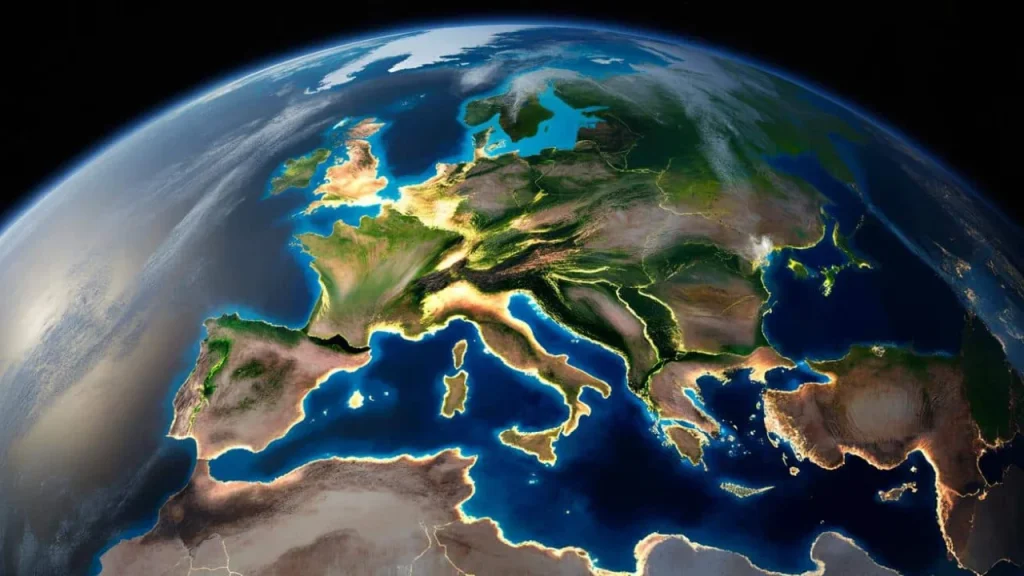

Imagine standing in Paris, looking out at the Eiffel Tower, knowing that in 250 million years this exact spot will be part of the world’s center stage. Not because of French cuisine or fashion, but because France will literally sit at the heart of Earth’s next supercontinent.

It sounds like science fiction, but geologists are deadly serious about this prediction. While we worry about next week’s weather or next year’s vacation plans, our planet is quietly orchestrating the most dramatic geographical makeover in Earth’s history.
The continents beneath our feet are already on the move, drifting toward an inevitable reunion that will completely reshape how Earth future continents look and function.

Why Our World Map Has an Expiration Date
Right now, Europe feels comfortably separated from the Americas by thousands of miles of Atlantic Ocean. Africa seems permanently positioned below Europe, and Asia stretches endlessly to the east. But this familiar arrangement is temporary—just a brief moment in geological time.
Earth’s continents ride on massive tectonic plates that never stop moving. They drift at roughly the speed your fingernails grow, about 2-4 centimeters per year. That might sound impossibly slow, but over 250 million years, it adds up to thousands of miles of movement.

“Think of it like a very slow-motion car crash that takes hundreds of millions of years to unfold,” explains Dr. Christopher Scotese from the PALEOMAP Project. “The continents are already heading toward their collision course.”
This isn’t guesswork. Scientists can track the direction and speed of tectonic plates using GPS satellites and geological evidence. The data shows Earth future continents are destined to merge into a new supercontinent called Pangea Ultima.

The Birth of Pangea Ultima: Earth’s Next Chapter
About 200 million years ago, all of today’s continents were stuck together in a massive supercontinent called Pangaea. When it broke apart, it created the Atlantic Ocean and gave us the modern world map we know today.
Now, the process is reversing. The Atlantic Ocean, which has been growing wider for millions of years, will start shrinking. Eventually, it will disappear entirely as the Americas drift back toward Europe and Africa.

Here’s what the new supercontinent will look like:
- Shape: A giant horseshoe-shaped landmass
- Size: Nearly all current continents merged into one
- Central location: Where Europe (including France) currently sits
- Surrounding features: A massive interior ocean where parts of today’s Indian Ocean will remain
France will find itself in an enviable position—right at the geographic center of this new supercontinent. Instead of being a mid-sized European country, it will occupy prime real estate in the heart of the world’s only major landmass.
“France will essentially become the crossroads of the world,” notes geophysicist Dr. Michael Gurnis. “It’s fascinating to think that Paris could one day be more central to global geography than it has ever been.”
| Current Ocean | Future Status in 250 Million Years | Impact on Nearby Regions |
|---|---|---|
| Atlantic Ocean | Completely closed | Americas collide with Europe/Africa |
| Pacific Ocean | Significantly smaller | Asia moves closer to Americas |
| Indian Ocean | Becomes interior sea | Australia merges with Asia |
| Mediterranean Sea | Eliminated entirely | Africa fully connects to Europe |
What This Means for Life on Earth
The formation of Pangea Ultima won’t just redraw maps—it will fundamentally change how life exists on our planet. Massive continental collisions will create new mountain ranges that dwarf today’s Himalayas. The climate will become more extreme, with scorching hot interiors and dramatically different weather patterns.
Ocean currents that currently moderate Earth’s temperature will be disrupted. Without the Atlantic to carry warm water northward, regions that are temperate today might become uninhabitably hot or cold.
But there’s a silver lining for France’s future position. Being centrally located in the supercontinent could provide some climate stability compared to the extreme edges of the landmass.
“Continental interiors typically experience more extreme temperatures, but central locations can sometimes be buffered from the worst effects,” explains paleoclimatologist Dr. Sarah Johnson. “France’s future location might actually be relatively favorable.”
The changes will affect more than just geography and climate:
- Biodiversity: Species currently separated by oceans will mix and compete
- Mineral resources: New mountain building will expose different ore deposits
- Sea levels: Less ocean space means higher global sea levels
- Volcanic activity: Continental collisions trigger increased volcanism
The Timeline of Transformation
This dramatic reshaping won’t happen overnight. The process will unfold over several key phases, each lasting tens of millions of years.
In the next 50 million years, Australia will collide with southeast Asia, creating new mountain ranges and closing parts of the Indian Ocean. The Mediterranean will continue shrinking as Africa pushes northward into Europe.
Around 100 million years from now, the Atlantic will start closing more rapidly. The Caribbean will be squeezed out of existence as North and South America approach Europe and Africa.
By 200 million years in the future, most of the major continental collisions will be underway. The familiar outlines of today’s continents will be unrecognizable as they crumple and merge together.
Finally, around 250 million years from now, Pangea Ultima will be complete. France will sit at the center of a world that looks nothing like today’s Earth.
“It’s humbling to realize that the geography we consider permanent is just a temporary arrangement,” reflects Dr. Scotese. “These cycles of continental breakup and reunion have happened before, and they’ll happen again.”
FAQs
Will humans still exist in 250 million years?
It’s impossible to predict, but complex life has survived previous supercontinent formations, so there’s reason for optimism about life continuing in some form.
Can we actually see the continents moving today?
Yes, with GPS technology we can measure continental drift in real-time, though the movement is only a few centimeters per year.
Will France really be at the center of the future supercontinent?
Based on current plate movement models, Europe including France will indeed occupy a central position in Pangea Ultima.
What will happen to islands like Britain and Japan?
Most islands will be incorporated into the larger continental masses as the oceans shrink and continents merge.
Could this timeline change?
While the general pattern is well-established, the exact timing and configuration could vary based on changes in plate tectonics that we can’t predict.
Will there be any oceans left?
Yes, there will still be a large interior ocean and likely some smaller seas, but the current Atlantic and Indian Oceans will be gone.