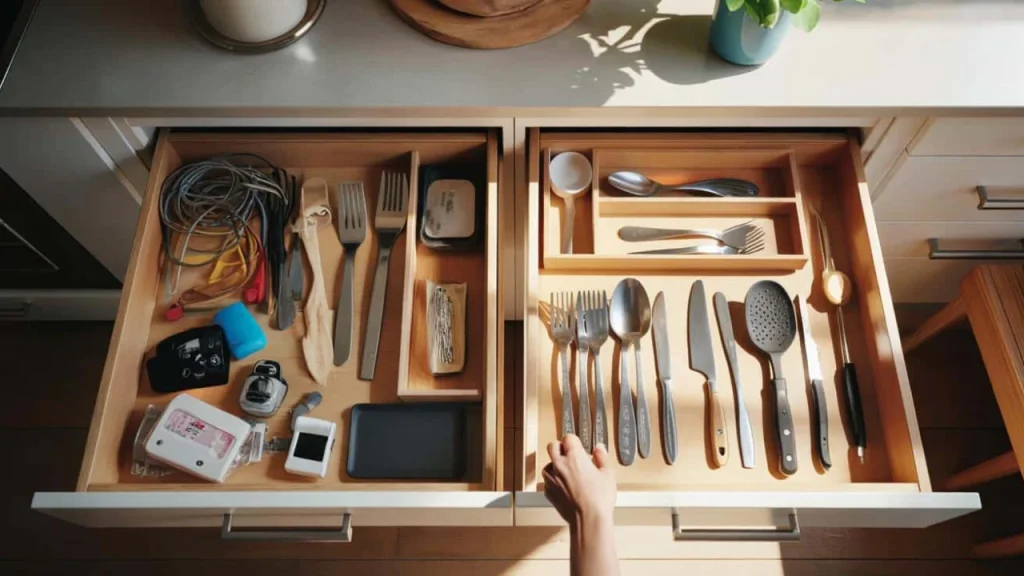

Sarah stared at her kitchen junk drawer, defeated. She’d spent two hours the night before organizing it with new dividers and cute labels. Everything had a place. This morning, she needed scissors to open a package, and somehow the entire drawer exploded. Batteries rolled everywhere, rubber bands tangled around pens, and the scissors were buried under a pile of takeout menus she forgot existed.

Sound familiar? You’re not alone in this drawer organization struggle. Millions of people buy organizers, watch YouTube tutorials, and promise themselves they’ll stay tidy this time. Yet within days, chaos returns like an unwelcome houseguest.
The problem isn’t your willpower or your organizing products. It’s something much simpler that most people never consider: where you actually place each object inside the drawer matters more than how pretty it looks.

The Secret Rule Professional Organizers Always Use
Professional organizers follow one golden rule that changes everything: place objects based on how often your hand reaches for them, not by category or size. This frequency-based placement is the foundation of sustainable drawer organization.
“Most people organize by what looks neat, but your brain works by habit,” explains organizing consultant Maria Rodriguez. “When you reach into a drawer, your hand expects to find daily items in the most accessible spots. Fight that instinct, and you’ll create chaos every single time.”

Think about your silverware drawer. If you use forks every day but they’re shoved in the back corner while serving spoons sit front and center, you’re forcing your hand to dig and displace items constantly. Within a week, everything shifts around as you unconsciously push things aside to reach what you actually need.
The same pattern happens in every drawer. Your bathroom drawer becomes a disaster because backup razors occupy prime real estate while your daily toothbrush sits buried. Your bedroom dresser turns chaotic because seasonal clothes block access to everyday underwear and socks.

The Three Zones That Keep Drawers Organized
Effective drawer organization depends on creating three distinct zones based on usage frequency. Here’s how to set up each zone for maximum success:
| Zone | Location | What Goes Here | Examples |
|---|---|---|---|
| A-Zone (Daily) | Front center | Items used daily or multiple times per week | Everyday utensils, underwear, phone charger |
| B-Zone (Weekly) | Sides and middle back | Items used weekly or bi-weekly | Measuring cups, nice clothes, backup cables |
| C-Zone (Monthly+) | Far back corners | Items used monthly or seasonally | Specialty tools, formal wear, holiday items |
“The magic happens when you stop fighting your natural reach patterns,” says professional organizer James Chen. “Place daily items where your hand naturally goes first, and the drawer practically maintains itself.”

Your A-Zone items should be grabbable without moving anything else. No digging, no shifting other objects. When you can open a drawer, reach directly for what you need, and close it again, you’ve created a sustainable system.
For B-Zone placement, these items can be behind or beside A-Zone objects, but still easily accessible when needed. C-Zone items can be tucked into corners or less convenient spots since you access them infrequently.
Why Most Drawer Systems Fail Within Days
Traditional organizing advice focuses on categories and aesthetics, but ignores how your brain actually works. When you organize by category alone—all kitchen tools together, all socks in one section—you create beautiful drawers that fight human behavior.
Research from the University of California found that people make over 200 micro-decisions daily just searching for household items. When frequently-used objects aren’t in expected locations, your brain experiences what researchers call “cognitive friction.” You get frustrated, rush through tasks, and unconsciously create mess while searching.
Here are the most common placement mistakes that doom drawer organization:
- Putting pretty organizers before considering usage patterns
- Storing daily items in hard-to-reach spots
- Mixing high-frequency and low-frequency objects in the same compartment
- Organizing by size instead of by how often you need each item
- Ignoring your dominant hand when deciding left vs. right placement
“I see people spend hundreds on drawer organizers, then wonder why nothing stays put,” notes organizing specialist Rebecca Martinez. “The organizers aren’t the problem. It’s that they’re organizing against their own habits instead of working with them.”
The solution starts with honest assessment. For one week, pay attention to what you actually grab from each drawer and how often. Don’t organize based on what you think you should use or what would look nicest. Organize based on reality.
The 15-Minute Reset That Actually Works
Here’s a simple system that works with your natural habits instead of against them:
Choose one problem drawer and empty everything onto your counter. Don’t sort by category yet. Instead, create three piles: items you used this week, items you used this month, and everything else.
The weekly pile goes back into prime spots—front center where your hand naturally reaches. Monthly items go in secondary positions. Everything else gets the leftover spaces or perhaps doesn’t belong in this drawer at all.
For kitchen drawers, this might mean your coffee scoop and everyday knife claim the best real estate, while specialty gadgets live in back corners. For bathroom drawers, daily toiletries get front billing while backup products stay tucked away.
The key is being brutally honest about your actual patterns, not your aspirational ones. If you never use that fancy apple corer, don’t let it occupy prime space just because it’s a “kitchen tool.”
Test your new arrangement for one week. If you find yourself digging or moving things to reach daily items, adjust the placement. The right system should feel effortless, like the drawer is designed around your specific habits.
FAQs
How long does it take for new drawer organization to feel natural?
Most people adapt to new placement within 3-5 days of consistent use, though it takes about 3 weeks to become completely automatic.
Should I buy organizers before or after arranging by frequency?
Always arrange by frequency first. Many people discover they need fewer organizers than expected once items are placed logically.
What if multiple people use the same drawer?
Focus on items that everyone uses frequently and place those in the A-Zone. Individual preferences can occupy separate sections of secondary zones.
How often should I reorganize my drawers?
Review placement every 3-6 months. Your usage patterns may change with seasons, life changes, or new purchases.
Can this method work for very small drawers?
Yes, even tiny drawers benefit from frequency-based placement. Just scale the zones to fit your space, keeping most-used items in the most accessible spots.
What’s the biggest mistake people make with drawer organization?
Organizing for how they think they should live instead of how they actually live. Successful organization follows your real habits, not ideal ones.