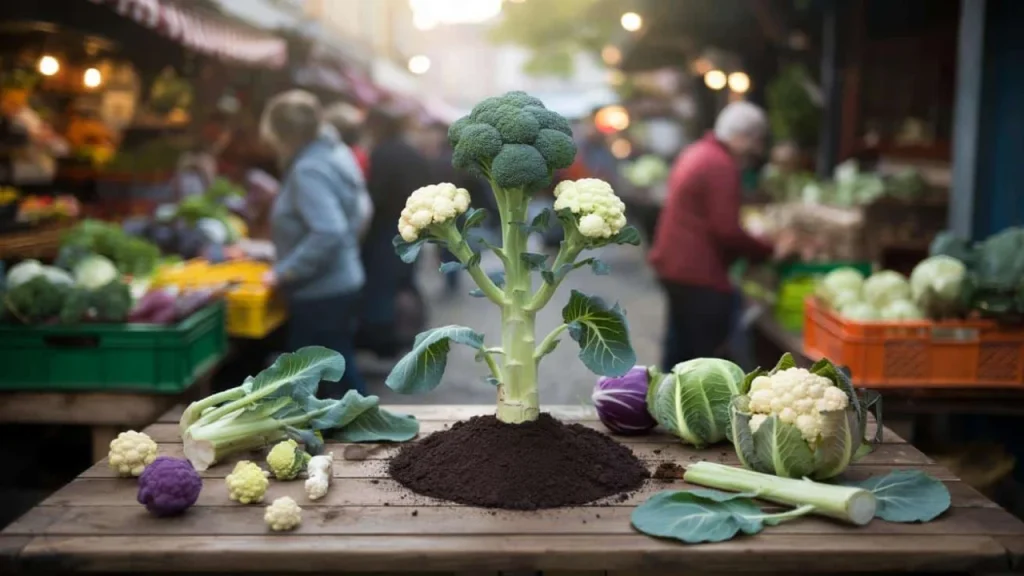

Last Tuesday at the grocery store, I watched a mom with two kids debate between broccoli and cauliflower. “Mom, I hate the white one,” her daughter complained. “But I like the green trees,” her son chimed in. The mom grabbed both, muttering something about vegetables being vegetables. If only she knew she was buying the exact same plant, just wearing different costumes.

Walking through that produce section, you see families making choices between what they think are completely different vegetables. Broccoli goes in one cart, cauliflower in another. Cabbage gets picked for coleslaw, Brussels sprouts for roasting. Nobody realizes they’re all shopping from the same botanical family tree.
That vendor at the farmer’s market had it right when he called them “cousins.” But the truth is even wilder than that – they’re more like identical twins who grew up in completely different households.

The Mind-Blowing Truth About These “Different” Vegetables
Here’s what most people don’t know: broccoli, cauliflower, cabbage, kale, Brussels sprouts, and kohlrabi are all the same species. Every single one of them is Brassica oleracea, just shaped by thousands of years of human selection.
Think about that for a second. The florets you steam, the leaves you chop for salad, the tiny cabbages you roast – they all started as one wild plant growing along the Mediterranean coastline.

“When I tell people this in my botany classes, their jaws drop,” says Dr. Sarah Martinez, a plant geneticist at UC Davis. “It’s like finding out all your favorite actors are actually the same person in different makeup.”
The original wild cabbage looked nothing like what we eat today. Picture a scraggly, bitter plant clinging to rocky shores, with loose leaves and tiny yellow flowers. Not exactly dinner material.

But our ancestors saw potential. Over centuries, different cultures focused on different parts of the plant, slowly breeding these brassica varieties into the vegetables we recognize today.
How One Plant Became a Whole Vegetable Family
The transformation didn’t happen overnight. It took generations of farmers selecting seeds from plants with the traits they wanted. Here’s how each variety developed:

| Vegetable | What Got Emphasized | When It Developed |
|---|---|---|
| Cabbage | Large, tight leaves forming heads | Around 1000 BC |
| Kale | Loose, nutritious leaves | 2000+ years ago |
| Broccoli | Dense flower clusters (florets) | Roman times |
| Cauliflower | White, compact flower heads | 15th century |
| Brussels Sprouts | Miniature cabbage-like buds on stem | 16th century Belgium |
| Kohlrabi | Swollen, bulbous stem | 15th century Germany |
The Romans were obsessed with broccoli – they called it “the five green fingers of Jupiter.” Meanwhile, people in northern Europe were developing Brussels sprouts, growing tiny cabbages up and down tall stems.
“Each culture took this one plant and said, ‘What if we made this part bigger?'” explains plant historian Dr. James Chen. “The Germans went after the stem, the Belgians wanted mini cabbages, the Italians loved those flower clusters.”
The really wild part? These vegetables can still interbreed. Plant a cauliflower next to a cabbage, let them flower, and their offspring might look like neither parent – or both.
What This Means for Your Kitchen and Health
Knowing these are all brassica varieties changes how you might think about cooking and nutrition. They share similar nutritional profiles because they’re basically the same plant.
All of them pack similar health benefits:
- High in vitamin C and vitamin K
- Rich in fiber and antioxidants
- Contain compounds called glucosinolates that may fight cancer
- Low in calories but high in nutrients
- Support immune system function
“From a nutritional standpoint, you’re getting similar benefits whether you choose broccoli or cauliflower,” notes registered dietitian Maria Rodriguez. “The main differences are in texture and taste, not health impact.”
This knowledge also explains why these vegetables often taste similar when prepared certain ways. Ever notice how roasted cauliflower and roasted Brussels sprouts have that same nutty, slightly sweet flavor? That’s their shared DNA talking.
For home cooks, this opens up possibilities. If a recipe calls for broccoli but you only have cauliflower, the substitution makes perfect botanical sense. They’re literally the same plant.
The Bigger Picture: What Selective Breeding Really Means
The story of brassica varieties isn’t just about vegetables – it’s about human ingenuity and our relationship with food. We didn’t just find these plants; we actively shaped them over thousands of years.
“This is one of the best examples of how humans have been genetic engineers for millennia,” says agricultural historian Dr. Patricia Wong. “We just did it with patience instead of laboratories.”
Today’s grocery stores showcase this ancient partnership. Every time you choose between green and purple cabbage, or debate broccoli versus broccolini, you’re seeing the results of countless farmers who saved seeds from their best plants.
The process continues today. Plant breeders are still developing new varieties – purple cauliflower, Romanesco broccoli, rainbow chard. Same species, new expressions.
This also raises questions about how we categorize food. If these are all the same plant, why do we treat them as completely separate vegetables? Some people love broccoli but hate Brussels sprouts, not realizing they’re rejecting their favorite vegetable in a different form.
FAQs
Are broccoli and cauliflower really the exact same plant?
Yes, they’re both Brassica oleracea, just bred to emphasize different plant parts – flower clusters in broccoli, compact white heads in cauliflower.
Can you cross-breed these vegetables with each other?
Absolutely, since they’re the same species. Broccoflower (green cauliflower) is actually a cross between broccoli and cauliflower.
Do all these vegetables have the same nutritional value?
They’re very similar nutritionally since they’re the same plant, though minor differences exist based on which plant parts we eat.
What did the original wild cabbage look like?
Nothing like modern vegetables – it was a scraggly plant with loose leaves and small yellow flowers, growing wild along Mediterranean coastlines.
How long did it take to develop these different varieties?
Hundreds to thousands of years of selective breeding, with some varieties like Brussels sprouts appearing as recently as the 16th century.
Why don’t they taste exactly the same if they’re the same plant?
Different plant parts have different textures and concentrations of compounds, plus breeding has emphasized different flavors over time.