
Picture this: you’re scrolling through your phone at 2 AM, asking ChatGPT to help with tomorrow’s presentation, when suddenly your screen goes dark. Not because your battery died, but because the local power grid just couldn’t handle another AI query. Sounds far-fetched? It’s closer to reality than you might think.

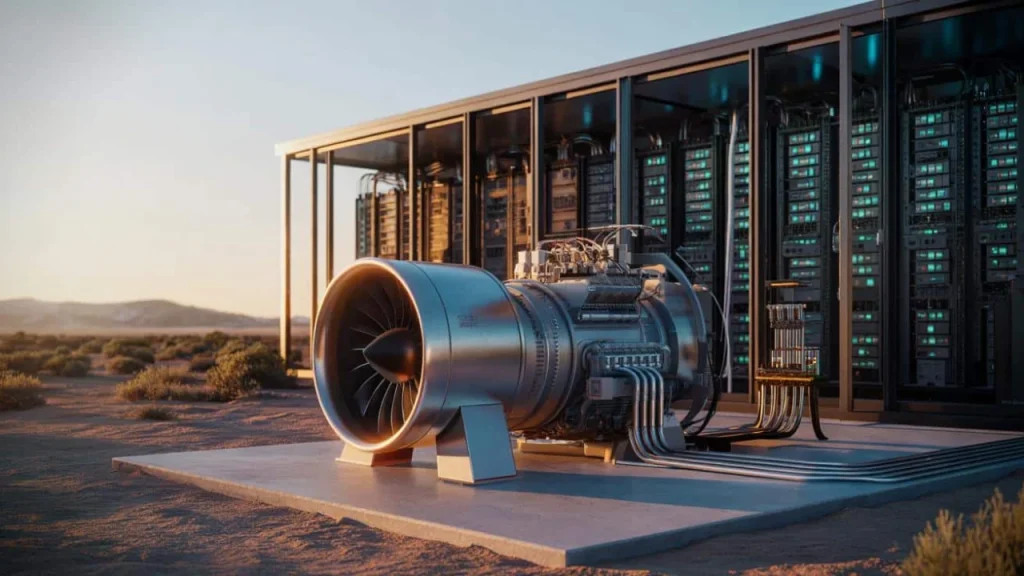
Across America, data centers are hitting an invisible wall. Not a technical one, but an electrical one. The same AI systems we’ve grown to rely on are literally outgrowing the power grid’s ability to feed them. And now, one company has come up with a solution that sounds like science fiction: using a supersonic jet turbine to power these digital workhorses.
This isn’t just about keeping your apps running smoothly. It’s about the future of how we generate power in an AI-driven world, and why sometimes the most unexpected technologies end up solving our biggest problems.
From Sky-High Speeds to Server Rooms
Boom Supersonic, the Colorado company racing to bring back supersonic passenger travel, has taken an unexpected detour. While their main focus remains the Overture supersonic airliner, they’ve discovered their jet engine technology has another calling: powering the data centers that run our digital lives.
Their solution, called “Superpower,” takes the high-temperature core from their Symphony supersonic jet turbine and repurposes it for a completely different mission. Instead of pushing a plane through the sound barrier, this 42-megawatt gas turbine will spin generators to feed rows upon rows of hungry computer processors.

“We’re essentially bringing the airport to the data center,” explains a Boom engineer familiar with the project. “If the power grid can’t keep up with demand, why not build your own power plant right next door?”
The first major customer, Crusoe Energy Systems, clearly believes in this vision. They’ve placed an order for 29 units worth $1.25 billion, representing about 1.21 gigawatts of total capacity. That’s enough electricity to power roughly 900,000 homes, all dedicated to artificial intelligence computations.

Why Data Centers Are Hitting a Power Wall
The numbers behind America’s data center power crisis are staggering. Here’s what’s really happening:
- AI training can require 10-100 times more electricity than traditional computing tasks
- Some regions are telling new data centers they’ll have to wait until the 2030s for grid connections
- Transmission line permits can take 5-10 years to approve and build
- A single large language model training run can consume as much electricity as 130 homes use in a year

The supersonic jet turbine approach addresses this bottleneck directly. Rather than waiting for utility companies to upgrade infrastructure, data center operators can generate their own power on-site.
| Power Source | Setup Time | Capacity | Grid Dependency |
|---|---|---|---|
| Traditional Grid Connection | 3-10 years | Variable | 100% |
| Superpower Turbine | 6-18 months | 42 MW per unit | 0-20% |
| Solar + Battery | 1-3 years | Variable | 50-70% |
| Traditional Gas Plant | 2-5 years | 100+ MW | 0% |
“The grid simply wasn’t designed for this kind of sudden, massive demand,” notes an energy industry analyst. “These companies need power now, not in five years.”
The Ripple Effects of Jet-Powered Computing
This shift toward on-site power generation using supersonic jet turbine technology could reshape how we think about both energy and computing infrastructure. The implications stretch far beyond just keeping servers running.
For consumers, this could mean more reliable AI services. No more wondering if ChatGPT will be slow because the local grid is overloaded. For businesses, it represents a path to energy independence that doesn’t require massive upfront investments in traditional power plants.
But there are trade-offs. Gas turbines, even efficient ones derived from supersonic jet engines, still produce carbon emissions. While Boom claims their Superpower system is cleaner than traditional grid power in many regions, environmental groups remain skeptical about expanding fossil fuel use for computing.
“It’s a pragmatic solution to an immediate problem,” says a data center sustainability expert. “But we need to make sure these temporary fixes don’t become permanent crutches.”
The technology also raises questions about energy equity. If major tech companies can afford their own supersonic jet turbine power plants, what happens to smaller businesses and residential customers who remain dependent on an increasingly strained grid?
Beyond the Hype: Real-World Challenges
Despite the $1.25 billion vote of confidence from Crusoe, the Superpower system faces significant hurdles. The technology hasn’t yet left the test phase, and adapting a supersonic jet turbine for stationary power generation involves complex engineering challenges.
Maintenance costs could be substantial. Jet engines require highly specialized technicians and expensive parts. Data centers typically prefer simple, reliable systems that can run for years with minimal intervention.
Regulatory approval represents another obstacle. Installing what amounts to a small power plant next to a data center requires permits from multiple agencies, environmental impact assessments, and community approval.
“The concept is brilliant, but execution will determine everything,” warns a former data center executive. “One major maintenance issue or regulatory delay could sink the entire business model.”
Yet the potential benefits are compelling enough to drive continued investment. As AI capabilities expand and computing demands skyrocket, the pressure to find alternative power solutions will only intensify.
FAQs
How does a supersonic jet turbine work for power generation?
The turbine uses the same high-temperature core technology designed for supersonic flight, but instead of providing thrust, it spins an electrical generator to produce power for data centers.
Is this more expensive than traditional grid power?
Initially yes, but companies factor in the cost of waiting years for grid connections and potential service interruptions. For time-sensitive AI projects, the premium may be worth it.
How environmentally friendly are these supersonic jet turbines?
They burn natural gas, so they do produce emissions. However, Boom claims they’re more efficient than many existing grid sources and can be located closer to demand, reducing transmission losses.
Could this technology work for other applications beyond data centers?
Potentially. Any facility with high, consistent power demands and limited grid access could benefit, including manufacturing plants, research facilities, or even residential developments in remote areas.
When will the first Superpower units actually start operating?
Boom hasn’t announced specific deployment dates, but given Crusoe’s order and the urgency of data center power needs, initial installations could begin within the next 2-3 years.
What happens if the supersonic jet program fails?
The power generation business could continue independently. The core turbine technology has applications beyond aviation, making it less dependent on Boom’s success in the airline industry.