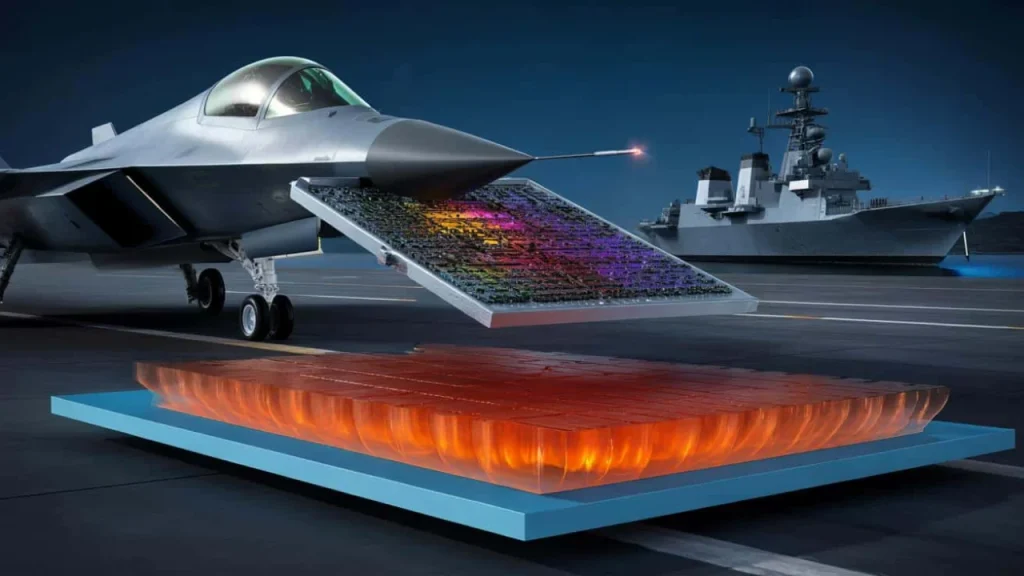

Picture this: You’re a fighter pilot streaking through hostile airspace at Mach 2, relying on your radar to spot enemy missiles before they spot you. Your aircraft’s radar system can theoretically see targets 200 miles away, but there’s a problem. The tiny chips powering your radar are literally cooking themselves from the inside out.

Within minutes, what should be your technological advantage becomes a liability. The radar starts throttling back its power to prevent a meltdown, and suddenly you’re flying half-blind into danger. This isn’t science fiction—it’s the reality facing military forces worldwide as they push radar technology to its limits.
Now, Chinese researchers claim they’ve solved this overheating problem that has plagued advanced radar systems for decades. Their breakthrough could reshape everything from air combat to your smartphone’s 5G connection.

Why Your Radar Chips Are Basically Tiny Ovens
Here’s the thing about modern military radars—they don’t fail because they can’t detect targets far enough away. They fail because they get too hot first. Every extra watt you pump into a radar transmitter gives you sharper images and longer detection range, but it also dumps more heat into a chip smaller than your fingernail.
These chips are made from gallium nitride, or GaN for short. Think of GaN as the Formula 1 car of semiconductor materials. It handles much higher voltages and power levels than older materials, which is why cutting-edge fighter jets like China’s J-20 and America’s F-35 rely heavily on GaN-based radar systems.

“Gallium nitride cooling has become the bottleneck that determines how powerful our radars can actually get,” explains a defense electronics engineer who works on military radar systems. “We can design chips that should work at incredible power levels, but the heat buildup kills them before they reach their potential.”
The problem gets worse at higher frequencies. When you’re dealing with X-band and Ka-band applications—the stuff used for missile guidance, long-range tracking, and advanced communications—these chips start cooking themselves faster than conventional cooling methods can handle.

The Hidden Layer That’s Been Holding Everything Back
Chinese researchers at Xidian University discovered that the real culprit wasn’t the main chip design. Instead, it was an ultra-thin “buffer layer” that most people never think about. This microscopic interface acts like glue between different materials in the chip stack.
Traditionally, this buffer layer is made from aluminum nitride. When manufacturers grow this layer using standard techniques, it doesn’t form a smooth, continuous sheet. Instead, it creates what researchers describe as “messy micro-islands”—imagine trying to conduct heat through a layer of gravel between two smooth tiles.

Here’s what makes this breakthrough so significant:
- Heat Transfer Boost: The new technique improves heat removal by up to 40% compared to standard buffer layers
- Power Density Gains: Chips can now operate at 30-50% higher power levels without overheating
- Reliability Improvement: Reduced thermal stress means components last significantly longer
- Frequency Performance: Better cooling enables operation at previously impossible frequencies
“We’ve essentially created a superhighway for heat to escape from the active region of the chip,” notes a materials science researcher familiar with gallium nitride cooling techniques. “It’s like replacing a bumpy dirt road with a smooth interstate.”
What This Means for Everything from Fighter Jets to Cell Phones
The implications extend far beyond military applications. Better gallium nitride cooling could revolutionize several key technologies:
| Technology | Current Limitation | Potential Impact |
|---|---|---|
| Military Radars | Power throttling due to heat | 50% range increase, better target discrimination |
| 5G Base Stations | Expensive cooling systems | Higher efficiency, lower operating costs |
| Satellite Communications | Limited transmission power | Stronger signals, better coverage |
| Electric Vehicle Chargers | Heat-related shutdowns | Faster charging speeds, improved reliability |
For consumers, this could mean faster internet speeds and more reliable wireless connections. For military forces, it represents a potential game-changer in radar capability and electronic warfare systems.
“The country that masters high-power gallium nitride cooling first will have a significant technological advantage,” warns a defense analyst who tracks radar technology developments. “This isn’t just about better performance—it’s about systems that can operate in conditions where current technology simply fails.”
The breakthrough also has major implications for space-based systems. Satellites operate in the vacuum of space where traditional cooling methods don’t work well. Better heat management means more powerful communication satellites and more capable space-based radar systems.
Racing Toward a New Era of Radar Technology
China’s timing with this breakthrough isn’t coincidental. The country has been investing heavily in GaN technology as part of its broader push to achieve technological independence in critical military and civilian technologies.
Meanwhile, U.S. and European defense contractors are scrambling to develop their own solutions to the gallium nitride cooling problem. The race is on to see who can first deploy these advanced cooling techniques in operational systems.
“We’re looking at a potential paradigm shift,” explains a radar systems engineer who has worked on both military and civilian applications. “For the first time in decades, we might be able to build radar systems where thermal limits aren’t the primary constraint.”
The commercial implications are equally significant. Companies like Qorvo, Wolfspeed, and other GaN chip manufacturers are closely watching these developments, as better cooling could unlock entirely new market opportunities.
FAQs
What exactly is gallium nitride and why is it important for radars?
Gallium nitride is a semiconductor material that can handle much higher power levels and frequencies than traditional silicon chips, making it essential for modern high-performance radar systems.
How does this cooling breakthrough actually work?
The technique creates a smoother, more continuous buffer layer between different materials in the chip, allowing heat to flow out more efficiently instead of getting trapped.
Will this technology appear in consumer electronics?
Yes, better gallium nitride cooling could improve everything from 5G networks to fast-charging systems for electric vehicles and smartphones.
How much of an advantage does this give China?
If successfully deployed, this could provide a significant edge in radar performance, potentially allowing Chinese systems to operate at power levels that would overheat competing technologies.
When might we see this technology in actual use?
Military applications could appear within 2-3 years, while consumer applications typically take 5-7 years to reach the market after initial breakthroughs.
Can other countries replicate this breakthrough?
While the basic concept is now known, reproducing the exact manufacturing techniques and achieving the same performance levels could take years of additional research and development.