
Sarah stared at her laptop screen in disbelief. After three months of steady work rating AI chatbot responses for $18 an hour, her contract portal showed nothing but a blank page. No warning email. No explanation. Just silence where her income used to be.

She wasn’t alone. Across the country, thousands of workers who train artificial intelligence systems are discovering that the AI boom comes with a harsh reality: while tech companies generate billions, the humans teaching their machines live paycheck to paycheck with zero job security.
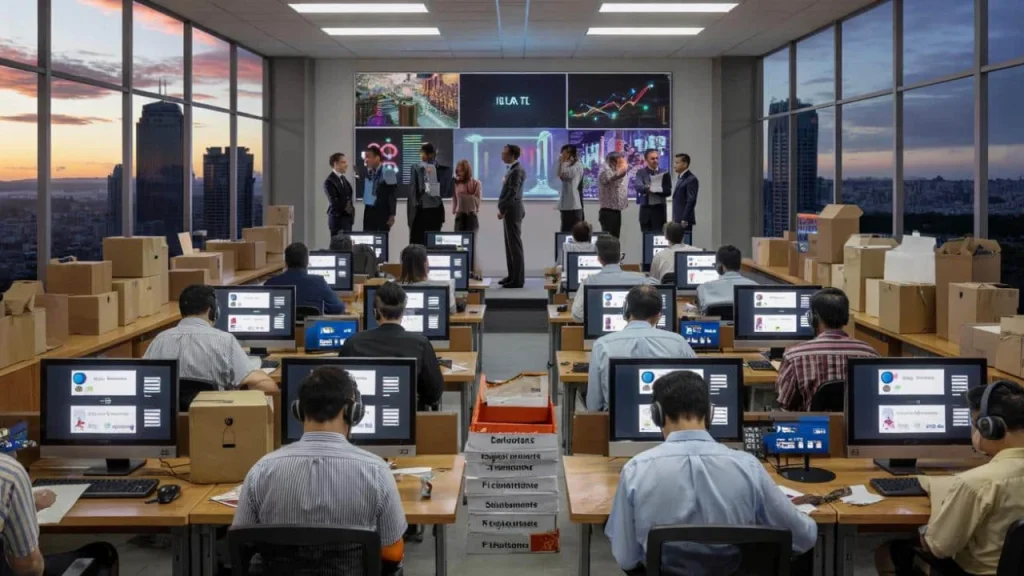
The recent mass layoffs affecting over 5,000 AI workers have pulled back the curtain on an uncomfortable truth. Behind every smooth ChatGPT conversation and perfect image recognition system, there’s an army of underpaid contractors doing the grunt work that makes AI possible.

The Hidden Army Behind AI’s Success
When you ask ChatGPT a question or use Google’s image search, you’re experiencing the end result of countless human hours. Real people labeled those images, rated those conversations, and taught these systems what good and bad responses look like.
“The fuel of AI is data labeled, checked and curated by humans – many of whom live with constant financial uncertainty,” explains Dr. Maria Rodriguez, a researcher studying AI labor practices at Stanford University.

These workers handle some of the most challenging content on the internet. They review hate speech to teach AI what to filter out. They rate search results for accuracy. They evaluate whether a chatbot’s response is helpful or harmful. It’s mentally demanding work that requires real human judgment.
Yet most of these essential workers earn between $15-25 per hour with no benefits, no sick days, and contracts that can disappear overnight. They’re classified as independent contractors, which means they shoulder all the financial risk while companies reap the rewards.

When 5,000 Workers Vanish Overnight
The story of Mercor, a US-based company working with Meta and OpenAI, perfectly illustrates this precarious situation. The company ran a project called “Musen” that employed over 5,000 workers to improve AI systems.
Workers were told the project would run through the end of the year. Many organized their entire lives around this promise – signing apartment leases, making car payments, planning family budgets.

Then, without warning, Musen was shut down. Workers logged into their portals to find their access revoked and their income stream cut off instantly.
The company quickly launched a replacement project called “Nova,” but with significantly lower pay rates. Workers who had been earning $20+ per hour were now offered tasks at $12-15 per hour for similar work.
| Project | Duration | Workers Affected | Pay Rate Change |
|---|---|---|---|
| Musen | 3 months | 5,000+ | $18-22/hour |
| Nova | Ongoing | Unknown | $12-15/hour |
| Similar projects | Varies | Thousands | 25-40% reduction |
“We went from having steady work that paid decent money to scrambling for whatever tasks we could find at much lower rates,” says James Chen, a former Musen worker who requested his real name not be used for fear of being blacklisted from future projects.
The Real Cost of AI’s Gold Rush
While AI companies celebrate record profits and valuations, the workers who make their success possible face increasingly difficult conditions:
- Pay rates have dropped 25-40% across major platforms in the past year
- Contract lengths have shortened from months to weeks or even days
- Competition for tasks has intensified as more workers enter the market
- No unemployment benefits when contracts end abruptly
- No health insurance or other benefits despite full-time work hours
The irony is stark. AI companies generate billions in revenue and achieve trillion-dollar valuations, yet they achieve these profits partly by keeping labor costs as low as possible.
“The AI industry has created a two-tier system where executives and engineers get stock options and high salaries, while the workers who actually train the AI systems scrape by on gig economy wages,” notes labor economist Dr. Patricia Williams.
This isn’t just about individual hardship. The entire AI industry depends on having enough skilled workers to continuously improve these systems. When companies prioritize short-term cost savings over worker stability, they risk undermining the human foundation their technology relies on.
What This Means for Everyone
The instability in AI underpaid labor markets affects more than just the workers directly involved. It reveals fundamental questions about how we want AI to develop and who should benefit from its success.
When the people training AI systems live in financial uncertainty, it affects the quality of that training. Stressed workers rushing through tasks to make ends meet may not catch subtle biases or errors that could later impact millions of users.
The current system also creates a brain drain. Many talented workers are leaving AI training work for more stable employment, even if it pays less overall. This reduces the pool of experienced workers available for increasingly complex AI training tasks.
“We’re seeing a race to the bottom in AI labor markets just as these systems become more important to society,” warns Dr. Rodriguez. “This shortsighted approach could seriously impact AI development quality in the long run.”
The recent layoffs have also exposed how little protection these workers have. Unlike traditional employees, they can’t collect unemployment benefits when projects end suddenly. They have no legal recourse when pay rates are cut without notice.
Some workers are trying to organize for better conditions, but the distributed nature of the work and fear of retaliation make collective action difficult. Most platforms prohibit workers from communicating directly with each other.
For consumers, this hidden instability means the AI services we rely on increasingly depend on an unsustainable labor model. As more workers leave for stable employment, the quality and responsiveness of AI systems could suffer.
FAQs
How much do AI training workers typically earn?
Most workers earn between $15-25 per hour with no benefits, though rates have been declining recently.
Why don’t these workers qualify for unemployment benefits?
They’re classified as independent contractors rather than employees, which excludes them from most workplace protections and benefits.
How many people work in AI training and data labeling?
Estimates suggest hundreds of thousands of workers globally, with tens of thousands in the US alone.
Can AI eventually replace these human workers?
While some simple tasks may be automated, complex judgment calls and quality control still require human oversight for the foreseeable future.
What happened to the 5,000 Mercor workers?
Their project was suddenly canceled, and while some found work on replacement projects, many faced significant pay cuts or had to find work elsewhere.
Are there any efforts to improve conditions for AI workers?
Some advocacy groups are pushing for better worker protections, but the distributed nature of the work makes organizing difficult.