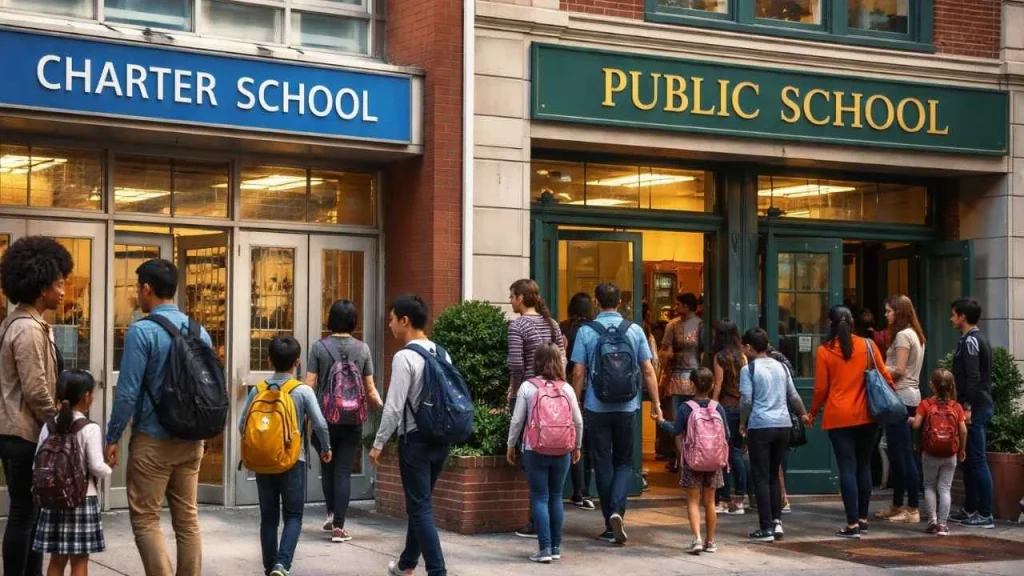

Choosing a school in New York City can feel overwhelming, especially when families must decide between traditional public schools and charter schools. Both are free, publicly funded, and open to NYC residents, yet their enrollment rules, timelines, and expectations differ in important ways.

Charter vs Public Schools in NYC
Many parents assume charter schools are simply another type of public school, but the enrollment process, family commitments, and student placement rules can vary significantly. Understanding these differences helps families avoid missed deadlines, confusion, and mismatched expectations.
This guide explains how enrollment works for charter schools versus traditional public schools in NYC, what parents should consider, and how to decide which option best fits their child.

Charter vs Public School Enrollment in NYC: Overview
| Feature | NYC Public Schools | NYC Charter Schools |
|---|---|---|
| Tuition | Free | Free |
| Enrollment system | NYC DOE centralized | Separate charter applications |
| Zoning | Yes (mainly elementary) | No zoning |
| Admissions method | Matching and placement | Lottery |
| Mid-year entry | Limited | Often allowed |
| Family commitments | Standard | Often more required |
What Are NYC Public Schools?
NYC public schools are operated directly by the New York City Department of Education. They include:
- Zoned neighborhood schools
- Citywide choice schools
- Specialized programs

Enrollment is managed centrally through NYC DOE systems.
Public schools must:

- Accept students living in their zone (if space allows)
- Follow citywide enrollment rules
- Serve all students, including those with special needs
What Are NYC Charter Schools?
Charter schools are publicly funded but independently run schools authorized by the state or other agencies.

Key characteristics:
- Not run by NYC DOE
- No attendance zones
- Set their own educational models
- Use random lotteries for admission
Charter schools must still follow public education laws but have more flexibility in operations.
How Enrollment Works for NYC Public Schools?
Public school enrollment depends on grade level.
Elementary and Kindergarten
- Zoned school priority
- Choice options available
- Guaranteed placement for eligible students
Middle School
- District-based or citywide choice
- Ranked application system
High School
- Fully citywide choice
- Matching algorithm
Families submit one application through NYC DOE for most grades.
How Enrollment Works for NYC Charter Schools?
Charter schools operate separate enrollment processes.
Key points:
- Families apply directly to each charter school or network
- Schools use lotteries when demand exceeds seats
- No academic testing for admission
- Preference may be given to siblings
Each charter sets its own deadlines, though many align with city timelines.
Lottery vs Matching: What’s the Difference?
The biggest difference is how seats are assigned.
- Public schools use a matching system based on preference and priority
- Charter schools use a random lottery
“Charter school lotteries are blind and random, while public school matching considers multiple factors,” said an education enrollment analyst.
Neither system guarantees admission to a specific school.
Zoning: A Major Difference
Zoning applies mainly to traditional public schools.
- Families have a local zoned school
- Zoned students receive priority
- Guarantees access in most cases
Charter schools:
- Have no zones
- Accept students from anywhere in NYC
- Do not guarantee placement based on address
Can Families Apply to Both?
Yes.
Families can:
- Apply to NYC public schools
- Apply to multiple charter schools
- Accept one offer only
Applying to a charter does not remove a child from public school eligibility.
Enrollment Timelines Compared
| Step | Public Schools | Charter Schools |
|---|---|---|
| Application period | Fixed DOE window | Varies by school |
| Offers released | On set dates | Lottery-based |
| Waitlists | Centralized | School-managed |
| Mid-year entry | Limited | More flexible |
Charter schools may continue enrolling after the school year starts.
Mid-Year Enrollment Differences
Public schools:
- Accept students year-round
- Assign based on zoning and space
- Transfers may be required
Charter schools:
- May fill seats mid-year
- Use waitlists
- Decide if late entry is allowed
This flexibility appeals to families who move during the year.
Special Education Enrollment
Both school types must serve students with disabilities.
Differences include:
- Public schools have dedicated DOE support structures
- Charters must provide required services but may rely on external providers
Placement should always be based on student needs, not school type.
Family Commitments and Expectations
Charter schools often ask families to:
- Sign commitment agreements
- Attend mandatory meetings
- Support school culture rules
Public schools generally:
- Do not require formal family contracts
- Follow standardized DOE policies
“Families should understand the level of involvement expected before enrolling,” said a parent engagement specialist.
Discipline and School Culture
Charter schools may:
- Have stricter behavioral policies
- Enforce uniform rules more strictly
- Emphasize structured environments
Public schools:
- Follow DOE discipline guidelines
- Offer more varied school cultures
Policies vary widely by school.
Transportation and Location
Public schools:
- Often closer to home
- Provide transportation based on eligibility
Charter schools:
- May be farther away
- Transportation policies differ by school
Commute time is a key consideration for many families.
What Happens If a Student Leaves a Charter School?
If a student leaves:
- They return to the public school system
- Placement depends on zoning and availability
- Re-enrollment is guaranteed somewhere
Charter attendance does not remove public school rights.
“Charter schools are not private, and public schools are not automatically inferior,” said an education policy expert.
Common myths include:
- Charters can pick students
- Public schools cannot remove disruptive students
- Charters are always higher quality
None are universally true.
How Parents Can Decide?
Families should consider:
- Child’s learning style
- Commute distance
- School culture
- Family availability
- Special education needs
Visiting schools and asking questions matters more than labels.
Impact on Families and Communities
School choice affects:
- Daily routines
- Family schedules
- Neighborhood schools
- Long-term planning
Informed choices reduce stress and increase satisfaction.
Final Thoughts
Charter schools and traditional public schools in NYC are both public options, but their enrollment systems, expectations, and flexibility differ significantly. Understanding these differences helps families choose confidently and avoid surprises.
The best school is not defined by its label, but by how well it fits a child’s needs and a family’s reality.
FAQs
Can charter schools charge fees?
No. They are tuition-free.
Can I apply to both public and charter schools?
Yes.
Do charter schools guarantee seats?
No. Admission is by lottery.
Does my address matter for charters?
No.
Will my child always have a public school seat?
Yes.