
Marine biologist Sarah Chen still remembers the moment she first saw a coelacanth fossil in her university textbook. The ancient fish looked like something from another world, with its thick, lobed fins and armored scales. “I never imagined I’d see one alive,” she told her professor that day in 2019.

Last month, she watched in stunned silence as footage emerged from Indonesian waters showing exactly that – a living, breathing coelacanth swimming gracefully through the deep. For the first time ever, French divers had captured this incredible “living fossil” on camera in the remote Maluku region, proving that some of Earth’s most ancient creatures still call our oceans home.
The discovery has sent ripples through the scientific community, reminding us that our planet still holds secrets waiting to be uncovered in its deepest, darkest places.

When Ancient Meets Modern in Indonesia’s Deep Waters
The coelacanth living fossil represents one of nature’s most remarkable survival stories. This extraordinary fish has remained virtually unchanged for over 400 million years, earning its nickname as a “living fossil” from scientists who once believed it had vanished with the dinosaurs.
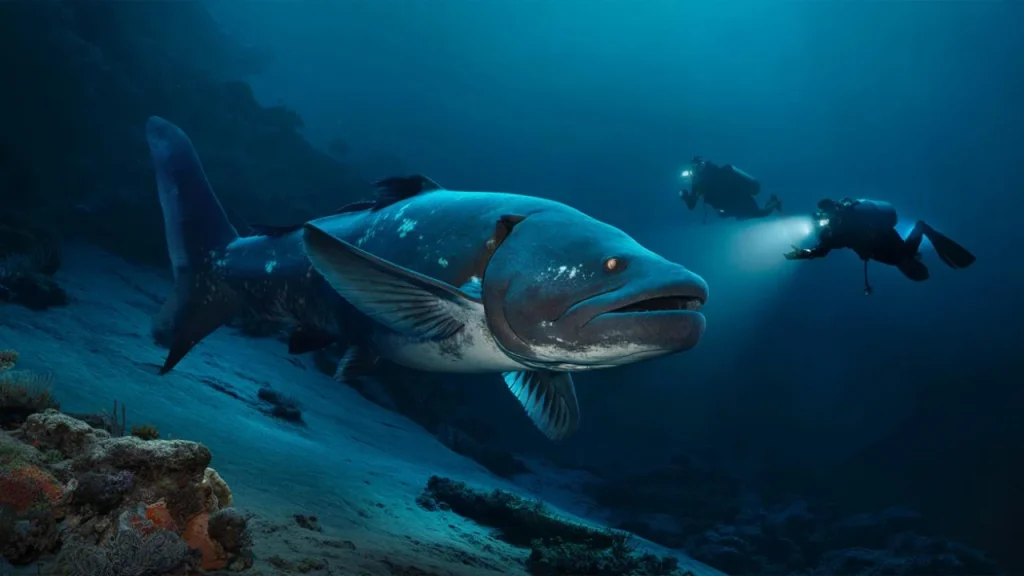
In October 2024, technical divers Alexis Chappuis and Julien Leblond made diving history when they descended 145 meters into the crushing depths off Indonesia’s Maluku Islands. Their mission wasn’t just about taking pretty pictures – it was about documenting a species so rare that every encounter matters for science.

“The moment we saw that distinctive silhouette in our dive lights, time seemed to stop,” Chappuis later described. “Here was a fish that had been swimming these waters since before the first trees grew on land.”
The pair used specialized closed-circuit rebreathers, technology that recycles exhaled gas and minimizes disturbance to marine life. At such extreme depths, this equipment isn’t just helpful – it’s the difference between life and death. One wrong move, and the crushing pressure could prove fatal.

What they found was breathtaking: a thick-bodied fish with midnight blue scales dotted with pale speckles, moving with the slow, deliberate grace of an ancient predator. The coelacanth seemed completely unbothered by its human visitors, circling calmly in open water for several precious minutes.
The Science Behind This Living Time Capsule
Understanding why the coelacanth living fossil matters requires looking at what makes this fish so incredibly special. These aren’t just old fish – they’re evolutionary treasures that bridge the gap between sea and land life.

Here’s what makes coelacanths scientifically priceless:
- Their fins contain bone structures similar to early land vertebrates
- They possess a primitive lung alongside their gills
- Their brain case contains mostly fat instead of brain tissue
- They can live over 100 years and don’t mature until age 55
- Females carry eggs internally for up to five years before giving birth
“These fish are like having a conversation with our own evolutionary past,” explains Dr. Michael Roberts, a marine evolutionary biologist. “Every detail of their anatomy tells us something about how life transitioned from water to land.”
The Indonesian discovery is particularly significant because it represents only the second known species of living coelacanth. Scientists have identified two distinct populations: the West Indian Ocean coelacanth found near the Comoros Islands, and the Indonesian coelacanth discovered near Sulawesi in 1998.
| Coelacanth Species | Location | Depth Range | Population Estimate |
|---|---|---|---|
| Latimeria chalumnae | Comoros Islands | 150-700 meters | ~300-400 individuals |
| Latimeria menadoensis | Indonesia | 150-200 meters | Unknown, very rare |
Why This Discovery Changes Everything We Know
The French diving team’s achievement goes far beyond getting spectacular footage. Their documentation provides the first in-situ behavioral observations of Indonesian coelacanths, offering insights that preserved specimens simply cannot provide.
Previous knowledge about these living fossils came primarily from dead specimens caught accidentally by fishermen or found washed ashore. Watching a coelacanth in its natural habitat reveals behaviors that scientists could only theorize about before.
The team observed the fish’s unique swimming style, using its paired fins in an alternating pattern remarkably similar to how four-legged animals walk on land. This “walking” motion underwater provides direct evidence of the evolutionary link between fish and terrestrial vertebrates.
“What struck us most was how purposeful every movement seemed,” noted Leblond. “This wasn’t a fish just drifting with the current – it was actively patrolling its territory with the confidence of a predator that has ruled these depths for millions of years.”
The discovery also highlights the critical importance of Indonesia’s marine biodiversity. The archipelago sits at the heart of the Coral Triangle, often called the “Amazon of the seas” for its incredible species richness.
The Race Against Time to Protect Living History
While the coelacanth’s survival for 400 million years might seem to guarantee its future, modern threats pose unprecedented challenges. Climate change, deep-sea fishing, and habitat destruction threaten the delicate ecosystems where these living fossils survive.
Indonesian waters face particular pressures from expanding fishing operations and potential deep-sea mining activities. The coelacanth’s extremely slow reproduction rate – females don’t reach maturity until their 50s and may only reproduce a few times in their century-long lives – makes population recovery nearly impossible once numbers decline.
“Every individual coelacanth represents millions of years of evolutionary history,” warns Dr. Lisa Martinez, a conservation biologist specializing in threatened marine species. “Losing even a small population could mean losing genetic diversity that took eons to develop.”
The French team’s work demonstrates how citizen scientists and technical divers can contribute to species conservation. Their two-year preparation process, involving detailed analysis of ocean temperatures, currents, and seafloor geology, shows the dedication required to find these elusive creatures.
Their success also proves that coelacanth populations may be more widespread than previously believed. If these ancient fish can be found in the Maluku region, they might inhabit other suitable deep-water habitats throughout Indonesia’s vast archipelago.
The footage and data collected will help researchers better understand coelacanth behavior, habitat preferences, and conservation needs. This knowledge becomes crucial as governments and international organizations work to protect deep-sea environments from increasing human pressures.
For now, the coelacanth continues its patient existence in the deep, carrying forward an evolutionary story that began when the first fish began dreaming of dry land. Thanks to dedicated divers and scientists, we’re finally getting a glimpse into that ancient world – one that reminds us how much we still have to learn about life on Earth.
FAQs
What exactly is a living fossil?
A living fossil is a species that has remained essentially unchanged for millions of years and was thought to be extinct based on fossil records alone.
How deep do coelacanths live?
Coelacanths typically live between 150 and 700 meters deep, in underwater caves and rocky crevices where the water is cool and dark.
Are coelacanths dangerous to humans?
No, coelacanths are completely harmless to humans and are actually quite shy, preferring to avoid contact with divers and other large animals.
How many coelacanths are left in the world?
Scientists estimate fewer than 1,000 coelacanths exist globally, with most living near the Comoros Islands and a smaller population in Indonesian waters.
Why are coelacanths important to science?
Coelacanths provide crucial insights into vertebrate evolution, particularly the transition from sea to land life, because their anatomy preserves features from our earliest ancestors.
Can coelacanths survive in aquariums?
No, coelacanths cannot survive in captivity due to their need for specific deep-water pressure and temperature conditions that are impossible to replicate in aquariums.