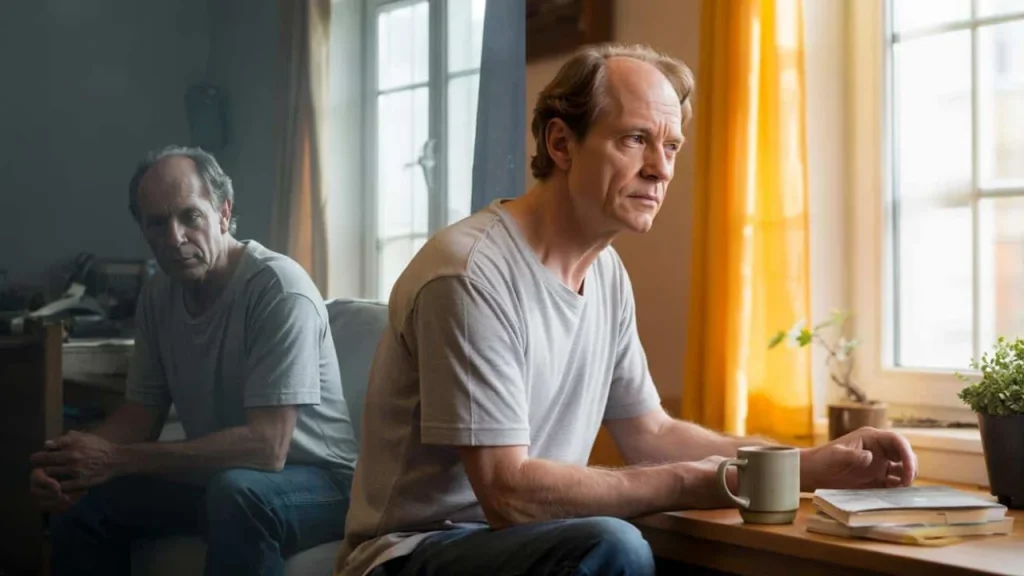

Sarah stared at her reflection every morning for twelve years, searching for the person she used to be. The woman looking back seemed like a stranger—hollow eyes, forced smile, going through the motions of life but never truly living. Depression had stolen her joy, her energy, her very sense of self. What she didn’t know was that across the country, a 44-year-old man was experiencing something far more severe: thirty-one years of unrelenting darkness with no break, no hope, and no treatment that worked.

His story was about to change everything we thought we knew about treating the most stubborn forms of depression. And it might just change everything for millions of people like Sarah too.
When Every Treatment Fails: The Reality of Treatment-Resistant Depression
Imagine trying twenty different keys on a lock that simply won’t open. That’s what this patient endured for over three decades. From the moment his depression began in adolescence, nothing provided lasting relief. Not antidepressants, not therapy, not electroconvulsive treatment, not any of the nearly twenty different approaches his doctors tried.

This isn’t uncommon. Treatment-resistant depression affects roughly one-third of people with major depressive disorder. For these individuals, the standard treatments that help millions of others simply don’t work. The condition becomes a prison with no visible exit.
“What we’re seeing here represents a completely new frontier in psychiatric treatment,” explains Dr. Jennifer Walsh, a neuroscientist studying depression therapies. “This patient had exhausted essentially every option available in modern psychiatry.”

The man’s daily reality included crushing apathy, constant negative thoughts, and an inability to plan or make decisions. Suicidal thoughts became background noise in his mind. His brain, it seemed, was locked in a pattern it couldn’t break free from—until scientists found a way to literally rewire it.
The Breakthrough: A Personalized Brain Implant
The solution came through a revolutionary approach called PACE (Personalized Adaptive Circuit Engagement). Instead of using a one-size-fits-all treatment, researchers created a custom brain implant specifically designed around this patient’s unique neural patterns.

Think of it like a sophisticated thermostat for the brain. Traditional deep brain stimulation delivers constant electrical pulses to predetermined areas. This new system is different—it reads the patient’s brain activity in real time and responds accordingly, delivering precise stimulation only when and where needed.
The research team focused on three interconnected brain regions that control mood, motivation, and emotional processing. By monitoring these areas continuously, the implant could detect when depressive patterns emerged and counteract them immediately.

| Treatment Approach | How It Works | Success Rate |
|---|---|---|
| Standard Antidepressants | Chemical rebalancing | 60-70% |
| Therapy + Medication | Combined approach | 70-80% |
| Traditional Deep Brain Stimulation | Fixed electrical pulses | 50-60% |
| Personalized Brain Implant (PACE) | Real-time adaptive stimulation | Promising early results |
Key features of this groundbreaking treatment include:
- Real-time brain activity monitoring
- Personalized stimulation patterns
- Adaptive responses to changing neural states
- Minimal side effects compared to medications
- Continuous 24/7 treatment without patient effort
“The beauty of this approach is that it’s like having a highly skilled psychiatrist monitoring your brain activity every second of every day,” notes Dr. Michael Chen, a pioneer in neurostimulation research. “It can catch and correct depressive episodes before they fully take hold.”
What This Means for Millions Struggling with Depression
The implications of this breakthrough extend far beyond one patient. Approximately 3.8 million Americans live with treatment-resistant depression, and current estimates suggest this number is growing as our understanding of the condition improves.
For these individuals, the new technology represents the first real hope they’ve had in years or even decades. While the treatment is still experimental and requires brain surgery, the results have been remarkable. The 44-year-old patient experienced significant mood improvements within weeks of the implant activation.
The ripple effects could transform how we think about mental health treatment entirely. Rather than relying on trial-and-error approaches with medications, doctors might soon be able to offer precisely targeted, personalized interventions based on each patient’s unique brain patterns.
“This isn’t just about depression,” explains Dr. Lisa Rodriguez, a clinical psychologist specializing in treatment-resistant conditions. “We’re potentially looking at a new model for treating various psychiatric conditions that have resisted traditional approaches.”
The economic impact could be substantial too. Treatment-resistant depression costs the U.S. healthcare system billions annually through repeated hospitalizations, disability claims, and lost productivity. A one-time procedure that provides lasting relief could dramatically reduce these costs while improving countless lives.
The Road Ahead: Hope Balanced with Caution
While the results are encouraging, scientists emphasize that this treatment isn’t ready for widespread use. The procedure requires highly specialized teams, expensive equipment, and carries the inherent risks of brain surgery. More research is needed to understand which patients might benefit most and to refine the technology further.
Current limitations include:
- High cost and complexity of the procedure
- Need for specialized surgical teams
- Unknown long-term effects
- Limited availability in clinical trials only
- Not suitable for all forms of depression
However, the success with this first patient has energized the research community. Multiple studies are now underway to test the approach in larger groups and refine the technology. Some researchers predict that within the next decade, personalized brain stimulation could become a standard option for treatment-resistant depression.
“We’re witnessing the birth of truly precision psychiatry,” says Dr. Chen. “This patient’s journey from thirty years of suffering to finding joy again shows us what’s possible when we can literally rewire the brain’s circuitry.”
For the millions of people who have felt trapped by treatment-resistant depression, this breakthrough offers something that’s been missing for too long: genuine hope for recovery when everything else has failed.
FAQs
What is treatment-resistant depression?
It’s a form of major depression that doesn’t respond to standard treatments like medication and therapy, affecting about one-third of people with chronic depression.
How does the brain implant work?
The device monitors brain activity in real time and delivers personalized electrical stimulation to specific regions when depressive patterns are detected.
Is this treatment available now?
No, it’s still experimental and only available through clinical trials at specialized research centers.
What are the risks of the procedure?
As with any brain surgery, risks include infection, bleeding, and potential complications from anesthesia, though the procedure is considered relatively safe.
How long do the effects last?
Early results suggest sustained improvement, but long-term data is still being collected as this is a new treatment approach.
Who might be a candidate for this treatment?
Patients with severe treatment-resistant depression who have tried multiple therapies without success and meet specific medical criteria for the experimental procedure.