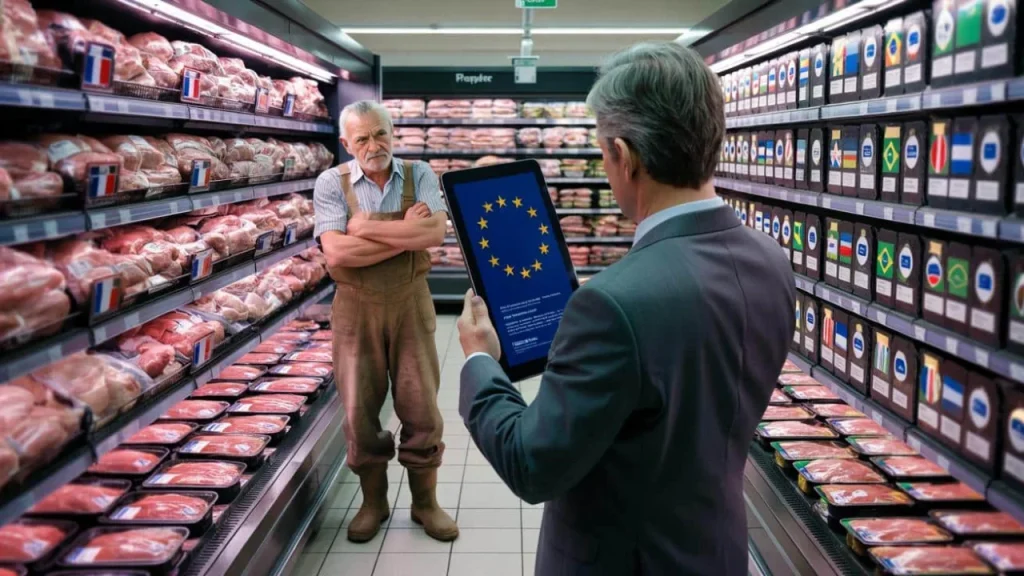

Marie-Claire stands in the meat aisle at her local Carrefour, holding a package of ground beef. The label says “Product of France,” but she wonders how much longer that will matter. Her farmer brother called last night, voice shaking with anger about the Mercosur trade deal. “They’re selling us out,” he said. “Soon, cheap South American meat will flood our stores.”

Now Marie-Claire stares at the shelves, wondering if her supermarket will even have a choice in what it stocks. The store manager she knows says his bosses are promising to refuse all Mercosur products. But can they really do that?
This question is keeping French retailers, farmers, and consumers awake at night as Europe edges closer to finalizing one of its biggest trade deals ever.
The Bold Promises French Supermarkets Are Making
French supermarket giants are drawing battle lines. In recent weeks, executives from Carrefour, E.Leclerc, Système U, and Intermarché have stepped up to microphones with the same defiant message: not one piece of South American meat will reach their shelves if the Mercosur trade deal goes through.
Thierry Cotillard, president of the Intermarché-linked “Mousquetaires” group, went furthest on French radio. He promised zero Brazilian chicken and zero Argentinian beef in his stores, calling the competition “completely unfair” and the trade rules unbalanced.
“We will stand with French farmers,” declared Michel-Édouard Leclerc, the retail chain’s president. “This deal threatens everything we’ve built.”
These statements aren’t just corporate posturing. They’re carefully calculated responses to massive farmer protests that have blocked roads and distribution centers across France. Agricultural unions are furious, claiming Brussels is sacrificing French farming on the altar of free trade.

But here’s the problem: the law doesn’t care about corporate promises or farmer protests.
What the Law Actually Says About Refusing Mercosur Products
Once the EU ratifies the Mercosur trade deal, it becomes European law. That creates a legal minefield for retailers making bold refusal promises.

Under EU competition rules, companies cannot organize collective boycotts based solely on a product’s country of origin. If Brazilian chicken or Argentinian beef meets EU safety standards and clears customs legally, refusing to stock it can be considered discriminatory commercial behavior.
“Retailers are walking into a legal trap,” explains trade law expert Professor Jean-Baptiste Dubois from Sciences Po Paris. “They can refuse products for legitimate reasons, but not simply because they come from Mercosur countries.”
The key legal challenges include:
- Competition law violations for organized boycotts
- Discrimination based on geographic origin
- Potential supplier contract breaches
- Consumer protection issues if alternatives become unavailable
Retailers could face hefty fines, legal challenges from suppliers, and even consumer lawsuits if their boycotts create artificial shortages or price spikes.
| Legal Risk | Potential Penalty | Likelihood |
|---|---|---|
| EU Competition Violation | Up to 10% of annual turnover | High |
| Supplier Contract Breach | Compensation claims | Medium |
| Consumer Protection Issues | Regulatory sanctions | Low |
| Trade Discrimination | EU court proceedings | High |
The Real-World Pressure Points
Beyond the legal complexities, practical realities make supermarket boycotts nearly impossible to sustain.
French consumers have shown they care more about price than origin when money gets tight. During the 2008 financial crisis, sales of cheaper imported meat actually increased despite “Buy French” campaigns.
“Consumers say one thing to pollsters and do another at checkout,” notes retail analyst Sophie Martineau. “When families face budget pressures, cheaper alternatives become attractive regardless of where they come from.”
Supply chain realities add another layer of complexity. Many processed foods contain ingredients from multiple countries. A French-branded frozen meal might contain Mercosur beef mixed with European vegetables. Tracking and removing every Mercosur component would be logistically nightmarish and expensive.
Major food manufacturers are also pushing back against retailer boycott plans. Nestlé, Danone, and other giants have significant South American operations and complex supply networks. They’re quietly warning retailers that blanket boycotts could disrupt existing contracts and product availability.
Restaurant chains face similar dilemmas. McDonald’s, Subway, and local bistros rely on competitive meat pricing to maintain profit margins. If retailers create artificial scarcity by refusing Mercosur products, food service prices could spike, hurting consumer spending across the economy.
What This Means for Your Shopping Cart
Despite the tough talk, most retail experts predict supermarket boycotts will quietly fade once the Mercosur trade deal takes effect.
Instead of outright refusals, stores will likely adopt subtler strategies:
- Promoting French products with premium positioning and marketing
- Creating separate “imported” and “local” sections
- Using private-label branding to obscure product origins
- Focusing on value-added French products that compete on quality rather than price
“Smart retailers will find ways to support French farmers without breaking European law,” predicts agricultural economist Dr. Philippe Chatellier. “It’s about marketing positioning, not product boycotts.”
French farmers, meanwhile, are preparing for a new competitive reality. Progressive producers are investing in organic certification, premium branding, and direct-to-consumer sales channels that emphasize local quality over price competition.
The government is also crafting support packages for agricultural modernization and marketing campaigns highlighting French food quality standards.
For consumers, the Mercosur trade deal will likely mean more choice and potentially lower prices on meat products. But it will also test how much French shoppers truly value supporting local farmers when their wallets feel the squeeze.
FAQs
Can French supermarkets legally refuse to sell Mercosur products?
Not based solely on origin. EU law prohibits discriminatory boycotts once trade agreements take effect, though stores can refuse products for legitimate quality or safety reasons.
What happens if retailers ignore the Mercosur trade deal?
They could face EU competition law violations with fines up to 10% of annual turnover, plus potential lawsuits from suppliers and regulatory sanctions.
Will Mercosur products be clearly labeled in stores?
EU regulations require country-of-origin labeling on fresh meat, but processed foods may not clearly indicate all ingredient sources.
How will this affect French farmers?
They’ll face increased competition from lower-priced South American products, forcing adaptation through quality improvements, organic certification, and premium branding strategies.
When will the Mercosur trade deal take effect?
The timeline remains uncertain as the deal requires ratification by all EU member states, with France strongly opposing the current terms.
Will food prices go down because of Mercosur?
Potentially yes for basic meat products, though retailers may maintain margins while farmers face pressure. Premium French products may actually increase in price to maintain differentiation.