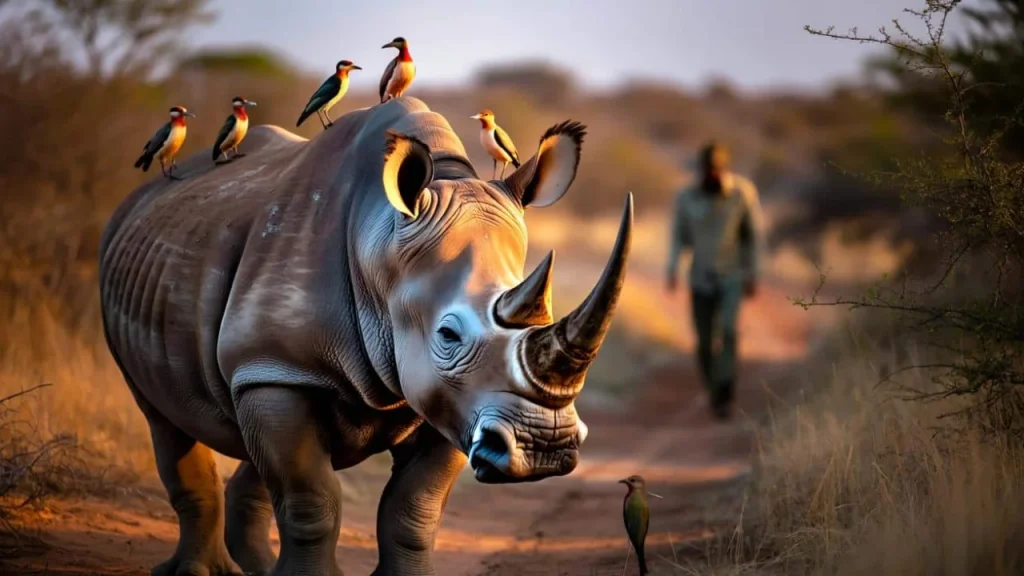

The ranger crouched behind a thorn bush, watching a massive black rhino graze peacefully just 30 meters away. On the animal’s back, three small birds pecked and shuffled, their red beaks flashing in the African sun. Suddenly, one bird let out a sharp, rattling cry. The rhino’s head snapped up instantly, ears swiveling. Within seconds, the two-ton giant had wheeled around and disappeared into the thick bush, taking his feathered passengers with him.

What the ranger witnessed wasn’t just lucky timing. It was a life-saving partnership that’s been quietly protecting one of Africa’s most endangered animals from human threats. The oxpecker rhino relationship has evolved into something far more sophisticated than anyone imagined.
For decades, scientists thought these small brown birds were simply opportunistic cleaners, hitching rides on large mammals to feast on ticks and parasites. The reality is much more fascinating and urgent.

Why Rhinos Put Up With Annoying Houseguests
Oxpeckers aren’t exactly polite companions. These birds jab their sharp beaks into thick skin, cling with needle-like claws, and shuffle around constantly. They’re not even particularly good at their supposed job of pest control.
Research shows oxpeckers often make things worse for their hosts. On cattle and buffalo, the birds have been caught pecking at open wounds, deliberately keeping them from healing to maintain a steady blood supply. Most large animals react predictably – they shake, twitch, or walk away to get rid of these irritating passengers.

But rhinos behave completely differently. Black rhinos, in particular, tolerate groups of oxpeckers for hours, even when the birds poke at sensitive areas around the ears and eyes.
“Rhinos clearly get something valuable from this relationship that goes way beyond tick removal,” explains Dr. Sarah Mitchell, a wildlife behaviorist who studies large mammal interactions. “They’re trading temporary discomfort for something much more important – survival.”

The Science Behind Nature’s Security System
A groundbreaking study in South Africa’s Hluhluwe-iMfolozi Park finally revealed what makes the oxpecker rhino relationship so special. Over 27 months, researchers followed 11 tagged black rhinos, carefully staging human approaches to test the animals’ detection abilities.
The results were striking:

| Condition | Detection Rate | Average Distance |
|---|---|---|
| Rhinos without oxpeckers | 23% | 27 meters |
| Rhinos with oxpeckers | 100% | 61 meters |
Each additional oxpecker added roughly 9 meters to the rhino’s detection range. That might not sound like much, but in the world of poaching, those extra seconds can mean the difference between escape and death.
The magic happens through the oxpecker’s alarm call – a harsh, repetitive cry that rhinos have learned to trust completely. When the sharp-eyed birds spot movement in the distance, their warning gives the nearsighted rhinos precious time to react.
“We’re witnessing evolution in real time,” notes conservation biologist Dr. James Hartley. “As poaching pressure intensifies, this partnership becomes more valuable than ever. The birds are literally acting as the rhino’s eyes and ears.”
A Partnership Shaped by Human Threats
This early warning system didn’t develop overnight. The oxpecker rhino relationship has been shaped by centuries of human hunting pressure, but it’s reached critical importance in recent decades as poaching has skyrocketed.
Modern poachers use sophisticated techniques – silent approaches, long-range weapons, and coordinated teams. A rhino’s poor eyesight, which was adequate protection against ancient predators, leaves them vulnerable to human threats.
The partnership benefits both species in surprising ways:
- Oxpeckers get reliable food sources and safe nesting spots
- Rhinos gain an early warning system against human approaches
- The birds help rhinos detect other threats like lions and hyenas
- Rhinos provide protection for oxpecker chicks in communal nests
Field observations show that rhinos with regular oxpecker companions survive poaching attempts at much higher rates than solitary animals. The birds have essentially become living security systems.
What This Means for Rhino Conservation
Understanding the true nature of this relationship is changing how conservationists approach rhino protection. Instead of focusing solely on anti-poaching patrols and horn removal, some programs now include oxpecker population management.
Protecting oxpecker nesting sites and food sources has become part of comprehensive rhino conservation strategies. Some reserves actively encourage oxpecker populations by maintaining the right mix of large mammals and minimizing pesticide use that could harm the birds.
“We used to think about species conservation in isolation,” explains wildlife manager Dr. Anna Rodriguez. “Now we’re learning that saving rhinos might depend on protecting a little bird that weighs less than 50 grams.”
The research has practical applications beyond rhino conservation. Similar partnerships exist between other large mammals and small warning species, suggesting that protecting keystone relationships could be more effective than protecting individual species alone.
Climate change and habitat loss threaten both partners in this ancient alliance. As grasslands shrink and tick populations change, oxpeckers face new challenges in finding food and nesting sites. Their declining numbers could leave rhinos even more vulnerable to human threats.
Yet there’s hope in the data. Reserves that actively protect both species see higher survival rates and more successful breeding. The oxpecker rhino relationship proves that sometimes the smallest allies make the biggest difference in conservation battles.
FAQs
How do oxpeckers help rhinos avoid poachers?
Oxpeckers have excellent eyesight and act as early warning systems, alerting rhinos to human approach with loud alarm calls that can be heard from great distances.
Do oxpeckers really clean parasites from rhinos?
While oxpeckers do eat some ticks, their main value lies in providing security rather than cleaning services. They often cause more irritation than they prevent.
Why don’t other animals tolerate oxpeckers like rhinos do?
Rhinos have evolved to tolerate the birds’ irritating behavior because the survival benefits outweigh the discomfort, especially under intense poaching pressure.
How many oxpeckers typically live on one rhino?
A rhino can host anywhere from one to twenty oxpeckers, with each additional bird adding about 9 meters to the animal’s detection range for potential threats.
Are oxpecker populations declining?
Yes, oxpecker numbers have decreased due to habitat loss and reduced host animal populations, which threatens this crucial partnership with rhinos.
Can this relationship help save other endangered species?
Similar warning partnerships exist between other large mammals and small birds, suggesting this conservation approach could benefit multiple threatened species.