
Maria Santos still remembers the first time she felt the ground shake beneath her feet in Hawaii. She was hiking with her family near Kilauea volcano when a mild tremor rippled through the earth. Her daughter grabbed her hand and asked, “Mom, why doesn’t the mountain just blow up and disappear like other volcanoes?”

That innocent question touches on something that has puzzled scientists for decades. While most volcanic systems flicker on and off like broken streetlights, Hawaii’s volcanoes have been remarkably steady for millions of years. The islands sit on what researchers call a “hotspot” – a column of hot rock rising from deep within Earth that creates volcanoes with clockwork precision.
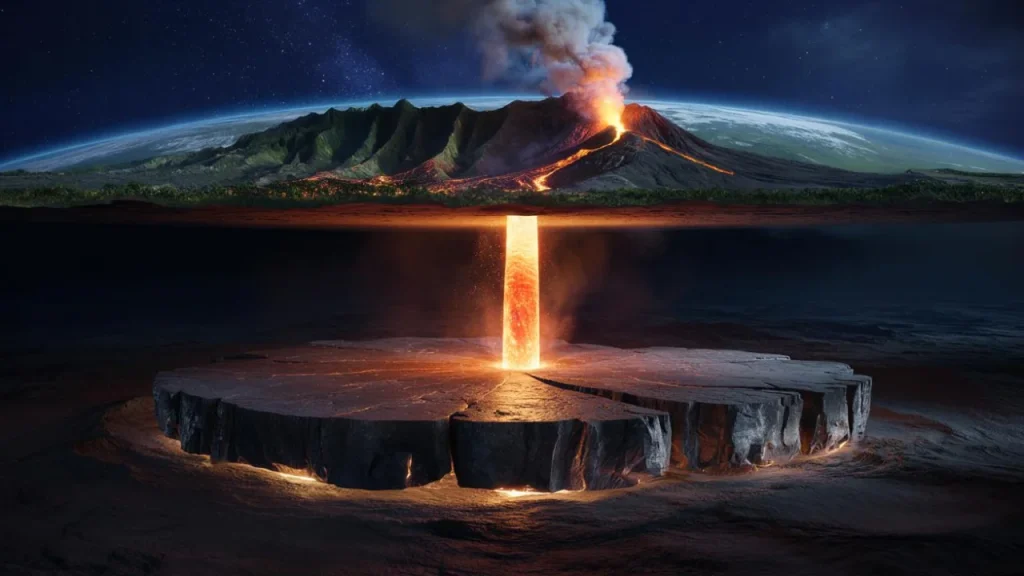
Now, scientists think they’ve found the answer to Maria’s daughter’s question buried nearly 3,000 kilometers below the Hawaiian islands. A massive, continent-sized block of iron-rich rock may be acting like a geological anchor, keeping the Hawaiian hotspot stability locked in place for tens of millions of years.
The Underground Giant Nobody Knew Existed
Imagine trying to understand what’s inside a locked box by shaking it and listening to the sounds. That’s essentially how scientists study the deep Earth. They track seismic waves from earthquakes as they travel through different materials, noting how the waves speed up or slow down depending on what they encounter.
Deep beneath Hawaii, these waves have revealed something extraordinary. At the boundary between Earth’s mantle and its molten core – nearly 2,900 kilometers down – sits a structure so large it defies easy description.

“We’re talking about something that stretches over 1,000 kilometers across and is 20 to 40 kilometers thick,” explains Dr. Jennifer Martinez, a seismologist who has studied similar structures. “It’s like discovering a hidden continent at the bottom of the ocean, except this ocean is made of rock.”
Scientists call these mysterious regions Ultra-Low Velocity Zones, or ULVZs, because seismic waves crawl through them at unusually slow speeds. The Hawaiian structure is so massive that researchers have dubbed it a “mega-ULVZ” – essentially a geological colossus sitting directly beneath one of Earth’s most active volcanic systems.

What Makes This Rock So Special
For years, scientists assumed these deep-Earth anomalies were pockets of partially molten rock – like thick syrup pooling at the bottom of Earth’s interior. But new research from teams at Carnegie Institution for Science, Imperial College London, and Seoul National University paints a very different picture.
Using advanced seismic imaging techniques, researchers discovered that Hawaii’s mega-ULVZ isn’t mushy or molten at all. Instead, it appears to be solid rock that’s extraordinarily rich in iron. Here’s what makes this discovery so significant:

- Size and scope: The structure spans more than 1,000 kilometers laterally – roughly the distance from New York to Atlanta
- Composition: Contains significantly more iron than typical mantle rock, making it denser and more heat-conducting
- Position: Sits directly beneath the Hawaiian hotspot, suggesting it plays a crucial role in volcanic activity
- Age: Likely existed for millions of years, potentially explaining long-term volcanic patterns
- Temperature effects: May help channel and focus rising columns of hot rock
“The iron content changes everything,” notes Dr. Robert Chen, a geophysicist studying mantle dynamics. “Iron-rich rocks conduct heat differently and can actually help guide the flow of molten material from below.”
The research team used a clever technique, comparing how different types of seismic waves slow down as they pass through the anomaly. The ratio between these slowdowns – called RS/P – acts like a fingerprint, revealing what the rock is made of.
| Measurement | Hawaiian Mega-ULVZ | Typical Mantle Rock |
|---|---|---|
| RS/P Ratio | 1.0 – 1.3 | 2.0 – 3.0 |
| Iron Content | Significantly Elevated | Standard Levels |
| Physical State | Solid | Solid |
| Lateral Extent | 1,000+ kilometers | 10-100 kilometers |
Why This Matters for Hawaii and Beyond
Understanding Hawaiian hotspot stability isn’t just academic curiosity. This research could revolutionize how we think about volcanic hazards, climate change, and even the formation of island chains around the world.
The discovery suggests that some of Earth’s most persistent volcanic systems may be anchored by these massive deep-Earth structures. For Hawaii specifically, this could mean:
- Predictable volcanic activity: The iron-rich block may help explain why Hawaiian eruptions follow relatively predictable patterns
- Long-term geological stability: The structure could continue channeling volcanic activity for millions more years
- Island formation patterns: May explain why the Hawaiian island chain formed in such a clear, linear sequence
“This research gives us a new lens for understanding not just Hawaii, but potentially other hotspots around the globe,” explains Dr. Sarah Kim, a volcanologist studying Pacific rim geology. “If similar structures exist under other volcanic systems, it could change how we assess long-term volcanic risks.”
The implications extend beyond Hawaii’s shores. Similar mega-structures might exist under other stable hotspots, such as Iceland or Yellowstone. Understanding these deep-Earth anchors could help scientists better predict where future volcanic activity might occur and how long it might persist.
For the millions of people who live near volcanic hotspots worldwide, this research offers both reassurance and new questions. While the discovery suggests that major hotspots like Hawaii may be more stable and predictable than previously thought, it also reveals how much we still don’t understand about the forces shaping our planet from below.
“Every time we peer deeper into Earth’s interior, we discover that our planet is far more complex and fascinating than we imagined,” notes Dr. Martinez. “This Hawaiian mega-structure is probably just the tip of the iceberg.”
The research team plans to use similar techniques to map other potential mega-ULVZs around the world, potentially uncovering a hidden network of deep-Earth structures that help control where and how volcanoes form on the surface.
FAQs
How deep is this giant rock structure beneath Hawaii?
The mega-ULVZ sits at the core-mantle boundary, approximately 2,900 kilometers (1,800 miles) below Hawaii’s surface.
Could this structure cause a massive volcanic eruption?
The research suggests the opposite – this iron-rich block appears to help stabilize volcanic activity rather than trigger catastrophic eruptions.
How did scientists discover something so deep underground?
They used seismic waves from earthquakes, tracking how the waves change speed as they pass through different materials deep within Earth.
Are there similar structures under other volcanoes?
Scientists suspect similar mega-structures might exist under other stable volcanic hotspots like Iceland and Yellowstone, but more research is needed.
What makes this rock different from normal mantle material?
The Hawaiian mega-ULVZ contains significantly more iron than typical mantle rock, making it denser and affecting how it conducts heat.
How long has this structure been there?
While the exact age is unknown, scientists believe it has likely existed for tens of millions of years, potentially explaining Hawaii’s long-term volcanic stability.