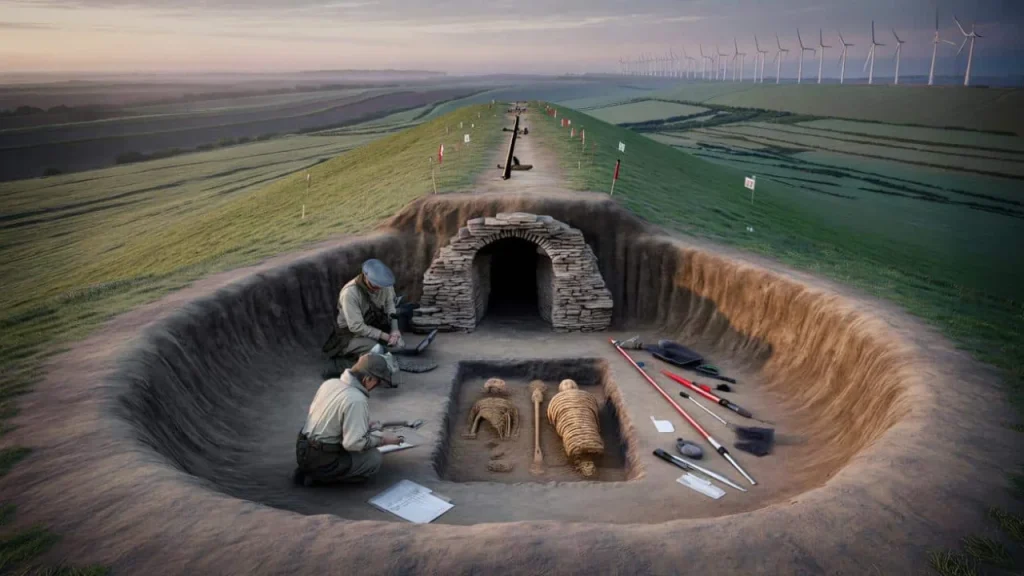

Picture this: you’re digging a secret tunnel beneath your village in medieval Germany, perhaps seeking shelter from raiders or creating a hidden passage. Your shovel hits something hard—ancient stones, old bones, remnants of people who lived and died thousands of years before your great-great-grandparents were even born. Do you stop? Do you find another route?
Apparently not. At least, that’s what happened near the German village of Reinstedt, where archaeologists have discovered something extraordinary that makes you wonder about the mindset of medieval tunnel diggers.
They kept digging anyway, carving their medieval tunnel straight through a 6,000-year-old burial ground, creating one of the most fascinating archaeological puzzles in recent memory.

When Ancient Meets Medieval Underground
The discovery happened during routine archaeological work ahead of a wind farm project in Saxony-Anhalt, central Germany. What started as a standard dig turned into something much more intriguing when researchers found a complex network of underground passages—known in German as an Erdstall—that had been deliberately carved through an existing Neolithic cemetery.
“This is like finding someone built a subway line through Westminster Abbey, except the time gap is measured in millennia rather than centuries,” explains Dr. Sarah Matthews, a medieval archaeology specialist not involved in the dig.

The medieval tunnel system consists of narrow, low passages barely high enough for a person to crawl through. These tunnels twist and snake just a few meters below the surface, creating a maze-like network that would have been extremely difficult to navigate in complete darkness.
What makes this find so remarkable isn’t just the tunnel itself, but what it cuts through. The hill had been a sacred burial site for Neolithic peoples around 4000 BCE, complete with individual graves, ritual ditches, and at least one substantial earthen burial mound.

The Mystery of Medieval Underground Networks
Erdställe represent one of medieval Europe’s most puzzling archaeological mysteries. Hundreds of these underground tunnel systems have been found across Bavaria, Austria, and eastern Germany, yet their true purpose remains hotly debated among researchers.
Here’s what we know about these mysterious medieval tunnels:

| Feature | Details |
|---|---|
| Width | Usually less than one meter |
| Height | Low enough to require crawling |
| Construction Period | 10th to 13th centuries CE |
| Geographic Distribution | Central and Eastern Europe |
| Access Points | Often hidden or extremely small |
| Internal Features | “Kneeling holes” and tight constrictions |
The design of these tunnels tells us something important: they weren’t built for comfort. The passages often include deliberate constrictions called “kneeling holes” where people would have to slide or wriggle through on their bellies.
“The uncomfortable nature of these spaces suggests they served a very specific purpose, whether practical or ritual,” notes tunnel researcher Klaus Weber. “You don’t build something this difficult to navigate unless you absolutely have to.”
Some theories about their use include:
- Emergency hiding places during raids or conflicts
- Storage areas for valuables during dangerous times
- Religious or spiritual retreat spaces
- Initiation sites for secret societies or religious groups
- Underground escape routes between buildings
What This Discovery Tells Us About Medieval Life
The Reinstedt find offers unique insights into how medieval communities interacted with their ancient past. Rather than avoiding the prehistoric burial site out of respect or fear, the tunnel builders seemingly ignored it entirely.
This raises fascinating questions about medieval attitudes toward ancient remains. Did they know they were digging through graves? Did they care? Or had the knowledge of what lay beneath simply been lost over the millennia?
“Medieval people often reused ancient sites, but usually above ground,” explains archaeological historian Dr. Michael Chen. “Finding a tunnel deliberately cut through prehistoric graves suggests a very different relationship with the past than we might expect.”
The discovery also highlights the layered nature of European history. The same piece of land served sacred purposes for Neolithic peoples around 4000 BCE, then became strategically important enough for medieval villagers to risk the dangerous work of underground tunnel construction.
Archaeological evidence suggests the medieval tunnel was likely built between the 11th and 13th centuries, during a period of frequent regional conflicts and political instability. This timing supports the theory that these underground networks served as emergency shelters.
Modern Implications and Ongoing Research
The Reinstedt discovery is already changing how archaeologists approach medieval tunnel sites. Previously, researchers focused mainly on the tunnels themselves. Now, there’s growing interest in understanding what these passages cut through and whether other Erdställe might have similar prehistoric contexts.
For local communities, finds like this create both opportunities and challenges. The site will likely become an important archaeological research location, potentially drawing academic interest and tourism. However, it also complicates land use planning and development projects.
“Every time we find something like this, it reminds us that the landscape is basically a historical layer cake,” says regional development planner Anna Zimmerman. “You never know what stories are waiting just below your feet.”
The research team plans extensive further excavation to map the complete tunnel network and better understand how it relates to the prehistoric burial site. They’re also using ground-penetrating radar and other non-invasive techniques to search for additional passages without disturbing the archaeological context.
Advanced dating techniques will help researchers pinpoint exactly when the medieval tunnel was constructed and how long it remained in use. Chemical analysis of soil samples might reveal clues about what activities took place in the underground spaces.
FAQs
What is an Erdstall?
An Erdstall is a type of narrow, low underground tunnel system built in medieval Central Europe, typically between the 10th and 13th centuries.
Why would medieval people dig through ancient graves?
Researchers aren’t certain, but it’s possible they either didn’t know about the prehistoric burials or considered their immediate needs more important than respecting ancient remains.
How old is the burial site that was disturbed?
The Neolithic burial ground dates back approximately 6,000 years, making it roughly 4,000 years older than the medieval tunnel.
Are there other similar discoveries?
While hundreds of medieval tunnels have been found across Europe, few have been discovered cutting through prehistoric sites, making this find particularly unusual.
What will happen to the site now?
The area will undergo extensive archaeological study before any wind farm construction proceeds, and significant portions may be preserved for future research.
Could this discovery change our understanding of medieval Europe?
Yes, it provides new insights into how medieval communities related to ancient sites and suggests these relationships were more complex than previously thought.