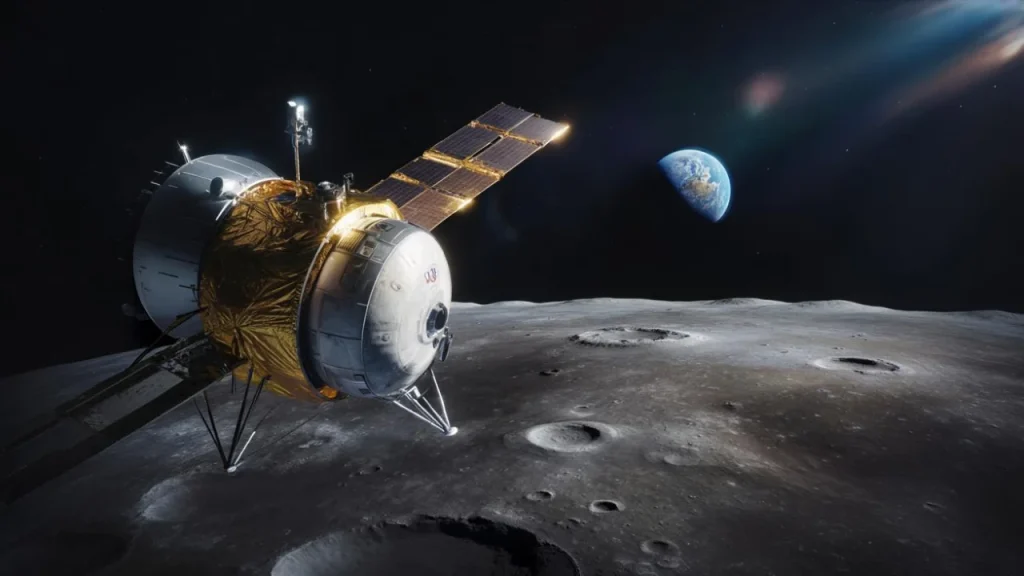

Picture this: you’re sitting in your living room, scrolling through your phone, when suddenly you realize that four people are about to travel farther from Earth than anyone has in over half a century. While you’re deciding what to have for dinner, they’re preparing to loop around the Moon in a spacecraft more powerful than anything humanity has ever built.

It sounds like science fiction, but the Artemis 2 mission is very real and very close. In just over a year, we’ll witness something our grandparents thought they’d never see again: humans venturing back toward the Moon.
This isn’t just another space mission. It’s the first step in humanity’s boldest plan yet – to not just visit the Moon again, but to stay there permanently.

Why the Artemis 2 Mission Matters Right Now
The Artemis 2 mission represents the most ambitious human space exploration effort since the Apollo era ended in 1972. Unlike those quick Moon visits from decades past, this mission is designed as the foundation for something much bigger.
Four astronauts will climb aboard NASA’s most powerful rocket ever created – the Space Launch System – for a ten-day journey that will take them around the Moon and back. But here’s what makes it special: they’re not going to land. Instead, they’re going to test every single system that future Moon explorers will depend on.

“This mission will push Orion to its absolute limits with real people inside,” explains a NASA mission planner. “We need to know exactly how this spacecraft performs before we trust it to land astronauts on the lunar surface.”
The launch window opens on February 6, 2026, giving NASA several weeks to find the perfect conditions. Weather, hardware readiness, and orbital mechanics all need to align perfectly for this historic flight.

Meet the Crew Making History
Four extraordinary people will make this journey, representing not just their countries but all of humanity’s return to deep space exploration:
| Astronaut | Agency | Background |
|---|---|---|
| Reid Wiseman | NASA | Mission Commander, former ISS astronaut |
| Victor Glover | NASA | Pilot, SpaceX Crew Dragon veteran |
| Christina Koch | NASA | Mission Specialist, holds record for longest single spaceflight by a woman |
| Jeremy Hansen | Canadian Space Agency | Mission Specialist, first Canadian to travel beyond Earth orbit |
These aren’t just highly trained professionals – they’re pioneers who will experience something no human has felt in over 50 years: watching Earth shrink to a small blue dot as they venture toward another world.

“We’re not just representing our agencies or countries,” notes a crew training specialist. “We’re carrying the hopes and dreams of everyone who’s ever looked up at the Moon and wondered what it would be like to go there.”
The Two-Phase Journey That Could Change Everything
The Artemis 2 mission unfolds in two distinct phases, each designed to test different critical systems that future lunar explorers will need.
Phase One: Earth Orbit Testing
After the thunderous launch from Kennedy Space Center, the crew will spend their first day in Earth orbit. But this isn’t a gentle cruise around our planet. Orion will complete two orbits, including one that stretches an incredible 74,000 kilometers from Earth – almost 200 times farther than the International Space Station.
- Manual flight control testing
- Proximity operations practice
- Life support system verification
- Communication system checks at extreme distances
Phase Two: The Lunar Flyby
Then comes the main event. Orion will fire its engines and break free from Earth orbit, beginning a four-day journey to the Moon. The spacecraft will swing around the lunar far side – the mysterious hemisphere we never see from Earth – before heading home.
During this phase, the crew will test everything from waste management systems to emergency procedures, all while traveling through the harsh radiation environment of deep space.
“Every single system on this spacecraft needs to work perfectly,” emphasizes a NASA engineer. “There’s no calling for help when you’re a quarter million miles from home.”
What This Means for Your Future
The success of Artemis 2 will directly impact how quickly humans return to the Moon’s surface. If everything goes according to plan, Artemis 3 could land the first woman and next man on the Moon as early as 2028.
But the implications go far beyond space exploration. The technologies being developed for lunar missions are already finding their way into everyday life:
- Advanced life support systems improving medical equipment
- Radiation shielding materials protecting airline crews
- Precision navigation systems enhancing GPS accuracy
- Solar panel efficiency improvements reducing energy costs
The international cooperation required for Artemis is also creating new partnerships that extend beyond space. Canada’s contribution to the mission, for example, has strengthened technological ties between North American space industries.
“This mission will inspire an entire generation of scientists, engineers, and explorers,” predicts a space policy analyst. “Just like Apollo did in the 1960s, Artemis will push humanity to achieve things we never thought possible.”
The economic impact is already visible. NASA estimates that the Artemis program will support over 70,000 jobs across the United States alone, with additional economic benefits flowing to international partners like Canada and the European Space Agency.
The Challenges They’ll Face
Make no mistake – this mission carries significant risks. The crew will face radiation levels hundreds of times higher than astronauts experience on the International Space Station. They’ll be farther from Earth than any rescue mission could reach.
The Orion heat shield must withstand temperatures of 5,000 degrees Fahrenheit when the spacecraft slams back into Earth’s atmosphere at 25,000 miles per hour. If it fails, there’s no second chance.
Weather delays could push the launch into less favorable orbital conditions. Technical problems could force mission planners to abort the lunar flyby and return early. Every day brings new challenges that the teams at NASA and partner agencies must solve.
But that’s exactly why they’re doing this mission first, before attempting a lunar landing. Better to discover problems during Artemis 2 than during a mission where astronauts are stranded on the Moon’s surface.
FAQs
How long will the Artemis 2 mission last?
The mission is planned for approximately ten days from launch to splashdown.
Will the astronauts actually land on the Moon?
No, Artemis 2 is a flyby mission. The first lunar landing is planned for Artemis 3.
How far will they travel from Earth?
The crew will travel approximately 240,000 miles from Earth during their lunar flyby.
What happens if something goes wrong during the mission?
Orion is equipped with multiple backup systems and can abort the lunar flyby to return to Earth early if needed.
Can I watch the launch?
Yes, NASA will provide live coverage of the launch and mission milestones through various media channels.
Why is this mission important for future Mars exploration?
The deep space experience and technology testing from Artemis missions will be essential for eventual human missions to Mars.