
Maria Santos had lived in her small Portuguese village for seventy-three years, walking the same cobblestone streets her grandmother once traveled. Last month, when her grandson showed her a GPS app on his phone, something strange caught her attention. The coordinates for her house had shifted slightly from what they were just five years ago.

“Technology must be broken,” she laughed, not realizing she had stumbled upon one of geology’s most fascinating discoveries. Her house hadn’t moved, but the entire landmass beneath her feet was slowly, imperceptibly spinning.
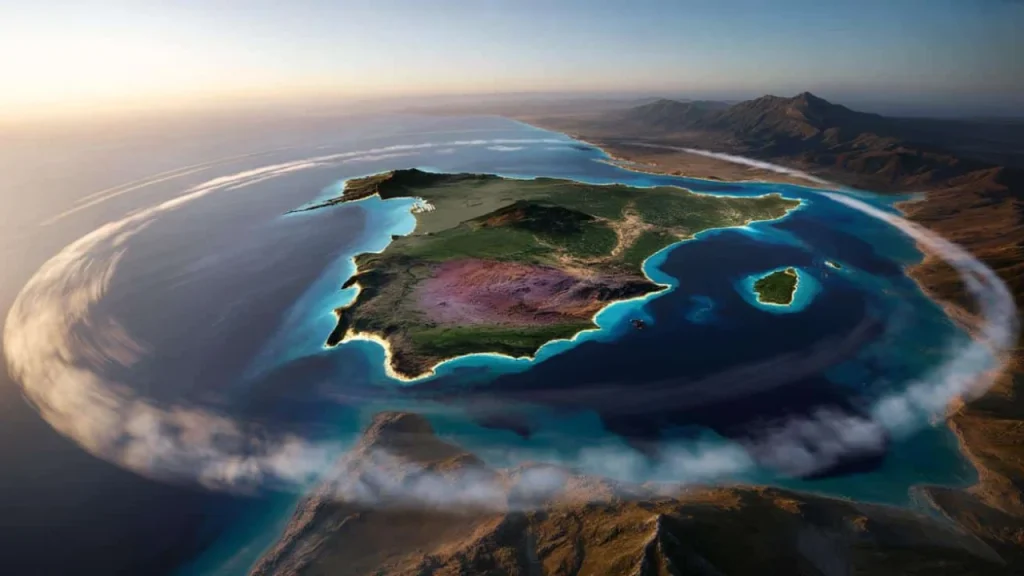
What Maria witnessed through modern technology reveals an extraordinary truth that geologists have recently confirmed: the Iberian Peninsula rotation is happening right now, turning Spain and Portugal like a massive stone wheel embedded in the Earth’s crust.

The Hidden Dance Beneath Our Feet
The Iberian Peninsula, home to over 58 million people, isn’t just drifting northward like most of Europe. Recent research published in Gondwana Research reveals something far more intriguing: the entire landmass is executing a slow clockwise rotation driven by the eternal collision between the African and Eurasian tectonic plates.
This isn’t your typical plate tectonics story. While textbooks often describe tectonic plates as conveyor belts sliding past each other in predictable patterns, the western Mediterranean refuses to follow the rules.

“The Iberian Peninsula is experiencing a slow clockwise spin, generated by uneven forces from the colliding African and Eurasian plates,” explains Dr. Asier Madarieta, lead researcher on the groundbreaking study.
The movement happens at a glacial pace. Africa and Eurasia approach each other at roughly 4 to 6 millimeters per year—about the same rate your fingernails grow. Yet this seemingly insignificant motion creates a complex twisting effect across southern Spain, Portugal, and the surrounding seafloor.

Why Iberia Spins Instead of Simply Sliding
Most plate boundaries operate like well-oiled machines. One plate dives beneath another, or two plates slide sideways along a clear fault line. But south of the Iberian Peninsula, geological chaos reigns.
The boundary between African and Eurasian plates becomes a confusing maze rather than a clean break. Stresses spread across a broad zone stretching from the Atlantic Ocean, through the Strait of Gibraltar, and into the western Mediterranean.

Here’s what makes the Iberian Peninsula rotation so unique:
- Compression forces arrive unevenly from the south
- Sideways pressure pushes from the Mediterranean
- Multiple smaller fault structures cut through the region
- Different sections of the boundary experience varying stress levels
“Instead of a single, obvious fault zone, we see stresses distributed across numerous smaller structures, each pulling in different directions,” notes geological researcher Dr. Carmen Rodriguez, who studies Mediterranean tectonics.
| Geological Feature | Movement Rate | Direction |
|---|---|---|
| Overall Iberian Rotation | 0.1-0.2 degrees per million years | Clockwise |
| Africa-Eurasia Convergence | 4-6 mm per year | Northward |
| Western Mediterranean Extension | 2-3 mm per year | East-West |
What This Spinning Means for Earthquake Risk
The discovery of Iberian Peninsula rotation isn’t just academic curiosity—it could fundamentally change how scientists assess earthquake risks across Spain and Portugal.
Traditional earthquake models assume plates move in straight lines. But if Iberia is spinning, stress patterns become far more complex. Fault lines that seemed stable might be accumulating tension in unexpected ways.
“Understanding rotational motion helps us better predict where earthquakes might occur and how intense they could be,” explains seismologist Dr. Miguel Torres, who monitors Mediterranean seismic activity.
The implications ripple across multiple areas:
- Building codes: Construction standards may need updates to account for rotational stress
- Infrastructure planning: Long-term projects like bridges and tunnels require geological stability assessments
- Emergency preparedness: Disaster response plans could be refined based on improved earthquake predictions
- Scientific research: Other supposedly “simple” plate boundaries might hide similar rotational movements
Portugal and Spain sit atop what geologists now recognize as one of the most geologically complex regions in Europe. The 1755 Lisbon earthquake, which devastated the Portuguese capital and triggered tsunamis across the Atlantic, likely resulted from these same complex forces now revealed to cause Iberian Peninsula rotation.
Living on a Spinning Continent
For residents of Spain and Portugal, this geological revelation changes nothing about daily life—yet everything about their understanding of home.
The rotation happens so slowly that human civilization could rise and fall multiple times before completing even a single degree of turn. Your great-great-great-grandchildren won’t notice their GPS coordinates shifting any more than Maria Santos did.
But the knowledge transforms how we perceive our relationship with the planet. Every step taken in Madrid, every sunset watched from a Portuguese beach, every meal shared in Barcelona happens atop a landmass engaged in an ancient, ongoing dance with continental forces.
“People often think of solid ground as permanent and unchanging,” observes geological educator Dr. Elena Vasquez. “But discovering that entire countries slowly spin reminds us that Earth remains a dynamic, living planet.”
The research team continues monitoring the Iberian Peninsula rotation using satellite measurements and ground-based sensors. Their work contributes to a growing understanding that plate tectonics operates with far more complexity and nuance than early geological models suggested.
As technology advances, scientists expect to discover similar rotational movements in other regions worldwide. The spinning Iberian Peninsula may represent not an exception, but a glimpse into the intricate choreography of continental drift happening everywhere beneath our feet.
FAQs
How fast is the Iberian Peninsula rotating?
The peninsula rotates extremely slowly, completing roughly 0.1 to 0.2 degrees per million years in a clockwise direction.
Can people living in Spain and Portugal feel this rotation?
No, the movement is far too slow to be perceptible to humans and won’t affect daily life in any noticeable way.
Will this rotation cause more earthquakes?
The rotation itself doesn’t increase earthquake frequency, but understanding it helps scientists better predict where and when seismic activity might occur.
Is this rotation dangerous for buildings and infrastructure?
No immediate danger exists, but the discovery may influence long-term construction planning and building code updates in the region.
Do other countries or continents also rotate like this?
Scientists suspect similar rotational movements occur elsewhere but are still researching other potentially spinning landmasses around the world.
What causes the Iberian Peninsula to spin instead of just moving straight?
Uneven pressure from colliding African and Eurasian plates creates a twisting force rather than simple linear movement, causing the clockwise rotation.