
Maria Petrenko remembers the first time her grandfather told her about the strange field behind their Ukrainian farmhouse. “There are old things buried there,” he’d whisper, pointing toward the seemingly empty grassland. “Things older than anyone knows.” As a child, she’d dismissed it as folklore. Now, decades later, as archaeologists carefully brush soil from ancient pottery shards in that very field, Maria realizes her grandfather might have been sitting on one of history’s most important secrets.

That unassuming patch of Ukrainian countryside is forcing us to completely rethink everything we thought we knew about where civilization began. For generations, we’ve been taught that the first cities emerged in Mesopotamia, nestled between the Tigris and Euphrates rivers. But new evidence suggests the real story of urban life might have started much closer to home—and much earlier than anyone imagined.
Ukraine’s Hidden Urban Revolution
Deep in central Ukraine, archaeologists are uncovering evidence of what might be the world’s first cities. These aren’t the kind of cities you’d expect from textbook illustrations of ancient Mesopotamia, with their towering temples and massive walls. Instead, these settlements challenge our very definition of what makes a city.

The site belongs to the Cucuteni-Trypillia culture, a sophisticated farming society that thrived between 5,400 and 2,700 BCE across modern-day Ukraine, Moldova, and Romania. What makes these settlements extraordinary isn’t just their age—it’s their sheer scale and organization.
“When we first started mapping these sites, we couldn’t believe what we were seeing,” explains Dr. Alexei Korvin-Piotrovskiy, a leading researcher on Trypillian archaeology. “Some of these settlements covered over 400 hectares and housed potentially 15,000 people. That’s massive for the time period.”

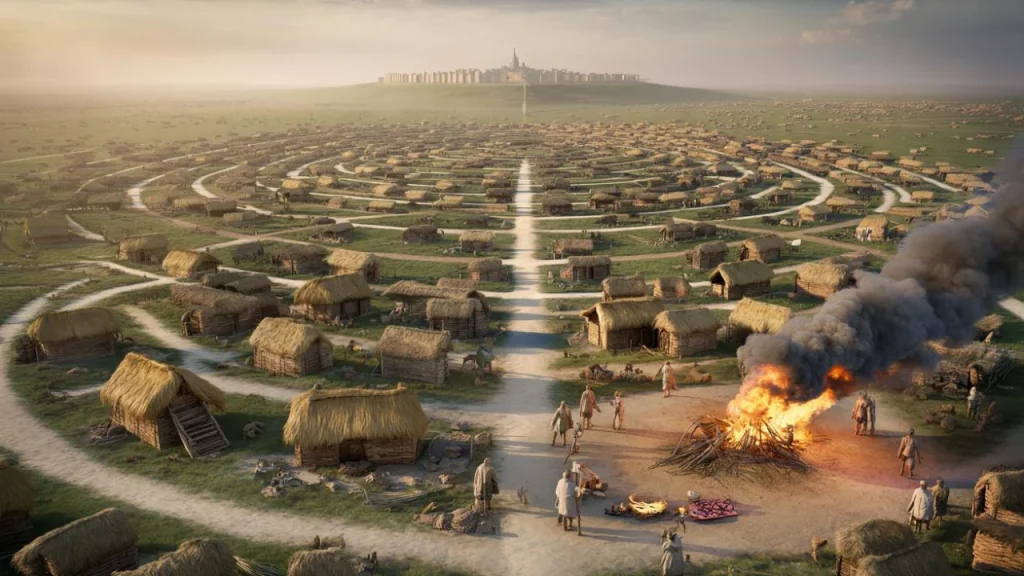
The largest of these ancient settlements, Talianki, sprawled across nearly 450 hectares—making it larger than many medieval European cities. Yet unlike their Mesopotamian counterparts, these communities had no defensive walls, no obvious ruling class, and no monumental architecture. Instead, they represent a completely different approach to urban living.
What Made These Ancient Cities Tick
The Trypillian settlements reveal fascinating details about how the first cities might have actually functioned. Recent excavations have uncovered a wealth of information that paints a picture of sophisticated urban planning without traditional markers of civilization.

Here are the key features that make these sites so remarkable:
- Standardized housing: Houses followed consistent designs and sizes, suggesting shared building codes
- Planned street layouts: Roads formed clear patterns and connected different neighborhoods
- Specialized craft areas: Different sections focused on pottery, metalwork, and textile production
- Central plazas: Large open spaces served as community gathering areas
- Sophisticated drainage: Evidence of planned water management systems
- Ritual burning: Houses were deliberately burned and rebuilt in cycles, possibly for spiritual reasons

Perhaps most intriguingly, these settlements appear to have operated without traditional hierarchies. “We don’t see palaces or temples dominating the landscape,” notes Dr. Mikhail Videiko, another expert on the culture. “Instead, we see evidence of remarkably egalitarian communities that somehow managed to coordinate massive construction projects.”
| Site Feature | Trypillian Cities | Mesopotamian Cities |
|---|---|---|
| Size | Up to 450 hectares | Typically 100-200 hectares |
| Population | 10,000-15,000 | 5,000-20,000 |
| Defensive walls | None found | Massive fortifications |
| Social hierarchy | Egalitarian evidence | Clear ruling classes |
| Time period | 4,000-3,200 BCE | 3,500-3,000 BCE |
Why This Discovery Changes Everything
The implications of these Ukrainian first cities extend far beyond academic archaeology. This discovery fundamentally challenges our understanding of how human civilization developed and spreads across the globe.
Traditional theories suggest that urban life emerged once, in Mesopotamia, then spread outward to influence the rest of the world. The Trypillian evidence suggests something far more complex: multiple societies independently discovered urbanism, each developing their own unique approaches to city life.
“We’re looking at parallel evolution of urban concepts,” explains Dr. Bisserka Gaydarska from Durham University. “These communities developed sophisticated city planning without any contact with Mesopotamian civilizations. It shows that the human drive toward urban living is much more fundamental than we realized.”
This has profound implications for how we understand human social development. Rather than following a single path from village to city, our ancestors apparently experimented with urban living in multiple ways across different continents.
The egalitarian nature of these settlements also challenges assumptions about why cities form. While Mesopotamian cities developed around temples and palaces, serving religious and political elites, the Ukrainian settlements seem to have emerged from community cooperation rather than top-down control.
Modern Lessons from Ancient Cities
These ancient Ukrainian settlements offer surprisingly relevant lessons for modern urban planners. Their emphasis on community spaces, sustainable practices, and egalitarian design principles resonates with contemporary discussions about creating more livable cities.
The cyclical burning and rebuilding of houses might seem wasteful to modern eyes, but it actually served multiple purposes: it prevented the accumulation of pests and diseases, renewed soil fertility through ash deposits, and may have served important social functions in community renewal.
“There’s something beautiful about communities that planned for regeneration rather than endless growth,” observes urban anthropologist Dr. Sarah Chen. “These people understood that cities need to breathe and renew themselves.”
The lack of defensive walls in these settlements also suggests that early urban life wasn’t necessarily driven by conflict and competition. Instead, these communities seem to have thrived through cooperation and shared resources.
Unfortunately, the Trypillian experiment ended around 2,700 BCE. Climate changes, population pressures, and possibly the arrival of nomadic groups from the steppes led to the abandonment of these remarkable settlements. Their lessons, however, remain remarkably relevant as we grapple with creating sustainable urban communities in the modern world.
FAQs
How old are these Ukrainian first cities?
The largest settlements date between 4,000-3,200 BCE, making them potentially 500-800 years older than the earliest known Mesopotamian cities.
How big were these ancient settlements?
The largest, Talianki, covered nearly 450 hectares and may have housed up to 15,000 people—comparable to many medieval European cities.
Why don’t these sites have walls or temples like other ancient cities?
The Trypillian culture appears to have developed a more egalitarian form of urbanism based on community cooperation rather than hierarchical control.
What happened to these early cities?
They were abandoned around 2,700 BCE, likely due to climate changes and pressure from nomadic groups, though the exact reasons remain debated.
How were these sites discovered?
Many were first identified through aerial photography showing crop marks, then confirmed through ground excavations over the past several decades.
Could there be other undiscovered early cities?
Absolutely—archaeologists believe many similar sites remain undiscovered across Eastern Europe, suggesting urban experimentation was even more widespread than currently known.