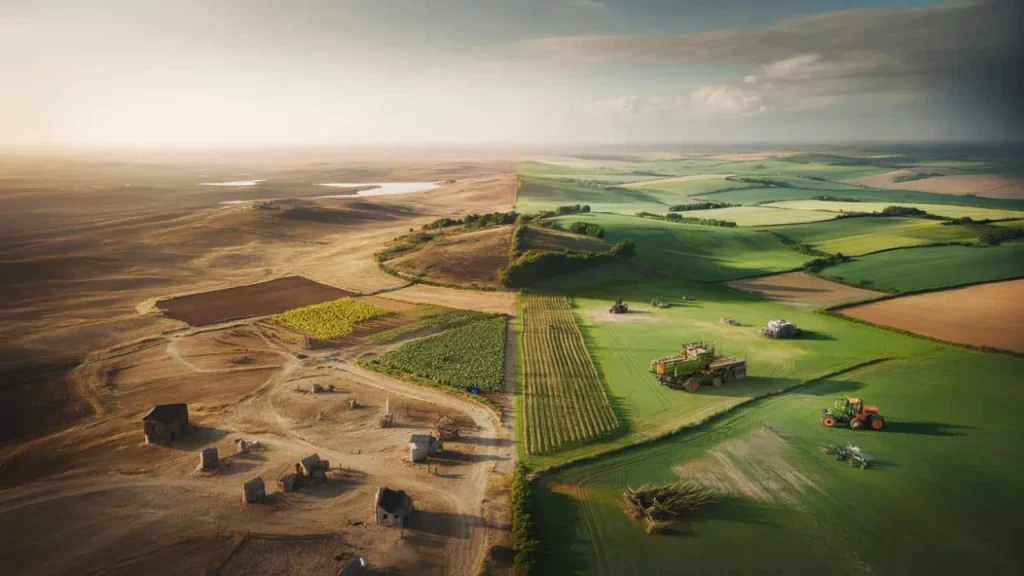

Maria Santos has farmed the same plot of land in southern Spain for thirty years. Her grandmother planted the first olive trees here, and her father expanded the vineyard that still produces wine today. But when she looked at the latest climate projections for her region last month, she felt something she’d never experienced before: the ground beneath her feet suddenly felt unstable.
The numbers were stark. Her farmland, worth roughly €800,000 today, could be worth less than half that by the time her children inherit it. It’s not just Maria facing this reality—across Europe, millions of farmers are about to discover that climate change isn’t just changing what they can grow, but fundamentally reshaping the value of their most precious asset.
What’s happening to European agriculture represents one of the largest wealth transfers in human history, and it’s happening quietly, field by field, season by season.

The Great Agricultural Shuffle Is Already Underway
The European Environment Agency has released projections that should shake every farmer, banker, and rural community leader across the continent. Their climate models paint a picture of dramatic farmland values shifts that will reshape the economic map of Europe by 2100.
The story is simple but brutal: as temperatures rise and rainfall patterns change, the best farming conditions are moving north. Southern and central European regions that have been agricultural powerhouses for centuries will see their farmland values plummet, while northern countries historically considered too cold for intensive agriculture will suddenly become goldmines.

“We’re looking at the most significant redistribution of agricultural wealth in European history,” explains Dr. Henrik Larsen, an agricultural economist at the University of Copenhagen. “This isn’t gradual change—it’s a fundamental restructuring of where food gets produced and who profits from it.”
Around 60% of European farmland is projected to lose value by century’s end, with some regions facing catastrophic drops of 60-80%. But this isn’t just about numbers on a balance sheet. Farmland values underpin everything from bank loans to retirement plans, from local tax revenues to rural employment.
Winners and Losers in Europe’s Climate Lottery
The transformation is creating unexpected winners and devastating losers. Countries that have spent centuries as Europe’s agricultural backwaters are suddenly positioned to become the continent’s new breadbaskets.
| Climate Winners | Expected Value Increase | Key Advantages |
|---|---|---|
| Sweden | 60%+ | Longer growing seasons, new crop possibilities |
| Denmark | 40-60% | Milder winters, reliable rainfall |
| Finland | 40-60% | Previously unusable land becomes productive |
| Ireland | 40-60% | Stable temperatures, consistent precipitation |
| United Kingdom | 40-60% | Northern regions gain growing capacity |
Meanwhile, the traditional agricultural heartlands face a different reality entirely:
- Southern Spain could see farmland values drop by 70-80%
- Parts of Italy face similar devastating losses
- Central European regions will experience significant value declines
- Mediterranean countries overall face the steepest losses
“We’re seeing Swedish farmers starting to plant crops their grandfathers never dreamed possible,” notes agricultural consultant Emma Björkström. “At the same time, Spanish farmers are watching their family lands become economically unviable.”
What This Means for Real People and Communities
Behind these statistics lie millions of human stories. Farmers who built their retirement plans around land equity will discover their nest eggs have shrunk. Rural communities dependent on agricultural tax bases will struggle to fund schools and infrastructure. Young people in affected regions will find fewer reasons to stay in farming.
The ripple effects extend far beyond individual farms. Food supply chains will need complete reconstruction. Investment patterns will shift dramatically. Even international trade relationships could change as northern European countries become net food exporters while southern regions become more dependent on imports.
“This isn’t just changing what crops grow where,” explains rural development specialist Dr. Catherine Mills. “It’s changing which communities thrive and which ones struggle to survive.”
Banks and lending institutions are already starting to factor climate risk into agricultural loans. Insurance companies are reassessing their models. Pension funds with farmland investments are quietly repositioning their portfolios.
The Technology and Adaptation Race
Some regions aren’t accepting their fate passively. Innovative farming technologies, drought-resistant crops, and new irrigation methods could help some areas maintain productivity even under challenging conditions.
However, the economics remain harsh. Even if technology allows continued production in heat-stressed regions, the costs of adaptation often exceed the value of the land itself.
“You can fight climate change with technology, but you can’t fight the economics,” warns agricultural finance expert Dr. Robert Chen. “When it costs more to maintain productivity than the land is worth, farmers face impossible choices.”
Northern European countries are meanwhile investing heavily in infrastructure to support their emerging agricultural advantages. New processing facilities, improved transportation networks, and expanded research programs are helping these regions capitalize on their climate windfall.
The Countdown Has Already Started
While the most dramatic changes won’t occur until later this century, the transition is already visible. Land prices in Scandinavia have been rising faster than inflation for several years. Spanish farmland prices have remained relatively flat despite population growth and economic expansion.
Smart money is already moving. International agricultural investment funds are quietly acquiring land in northern European countries while divesting from Mediterranean properties. Family farmers often don’t have the luxury of such strategic flexibility.
The message for current landowners is stark: the time for adaptation is now, not later. Those who wait for the changes to fully manifest may find themselves holding assets that have already lost much of their value.
FAQs
When will these farmland value changes actually happen?
The changes are already beginning, but the most dramatic shifts are projected to occur between 2050 and 2100.
Can technology prevent these value losses in affected regions?
While technology can help maintain some productivity, the high costs often make farming economically unviable even with technological solutions.
Will northern European countries really be able to replace southern European agriculture?
Northern regions will gain capacity, but they’ll likely specialize in different crops than those traditionally grown in the south.
How should current farmers in affected regions prepare?
Experts recommend diversifying income sources, exploring climate-adapted crops, and considering gradual transitions away from farming if economically feasible.
Will food prices rise because of these changes?
Potentially, especially during the transition period when supply chains are disrupted and new production systems are still developing.
Are there any government programs to help affected farmers?
Some EU programs exist, but they’re not yet scaled to address the magnitude of changes projected by climate models.