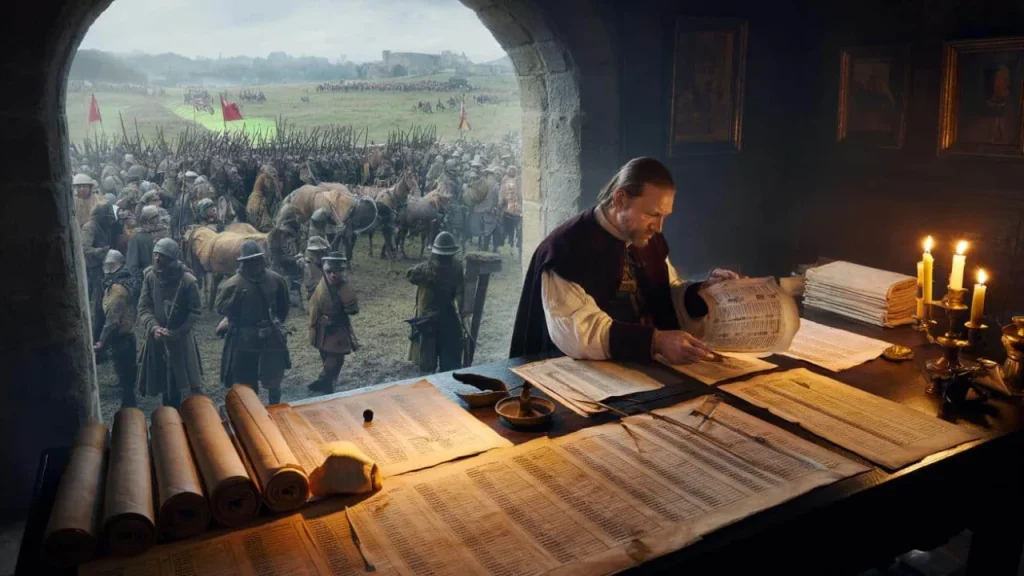

Thomas Archer was just another name on a dusty parchment roll until researchers started digging deeper. Listed in the military records of 1415, this English archer served at the Battle of Agincourt—but that’s where most history books would end his story. The Medieval Soldier Database reveals something far more fascinating: Thomas wasn’t a one-time conscript dragged from his village. He served for over fifteen years, fought in three different campaigns, and earned enough to buy land back home.
His story isn’t unique. Across nearly 300,000 digitized records, we’re discovering that medieval English soldiers lived lives far more complex and professional than Hollywood would have us believe. These weren’t just peasants with pitchforks—they were career military men with ambitions, families, and surprisingly modern concerns about pay and promotion.
Behind every famous king and heroic painting lies a mountain of forgotten paperwork that’s quietly rewriting what we know about medieval warfare and the ordinary people who fought those wars.

The Database That’s Changing Medieval History
The Medieval Soldier Database represents one of the most ambitious historical projects of the digital age. Launched in 2009 and now hosted by the University of Southampton’s GeoData institute, this online resource has transformed scattered Latin documents into searchable records spanning nearly a century of English military service.
The database covers the period from the late 1350s to 1453—essentially the entire duration of the Hundred Years’ War with France. What makes it revolutionary isn’t just its size, but its focus on individual soldiers rather than grand strategy or famous battles.

“For the first time, we can track individual careers across multiple campaigns,” explains Dr. Anne Curry, one of the project’s leading historians. “We’re seeing soldiers who served for decades, not just single battles.”
These records come primarily from “musters”—official military lists that captains had to present to royal officials. Each muster detailed who was serving, their role, their pay grade, and often their location, from Norman siege camps to remote French garrisons.

What the Numbers Actually Reveal About Medieval English Soldiers
The database contains nearly 290,000 entries, making it the world’s largest searchable collection of medieval soldier names. But the real treasure lies in what these numbers tell us about military life in the Middle Ages.
Here’s what emerges when you crunch the data:

| Service Type | Percentage | Average Service Length |
|---|---|---|
| Archers | 65% | 8.3 years |
| Men-at-Arms | 25% | 12.1 years |
| Officers | 10% | 15.7 years |
The most striking discovery is how professional these armies really were. Instead of the feudal rabble of popular imagination, the records reveal:
- Many soldiers served 20+ years across multiple campaigns
- Career progression was common—archers could become sergeants, sergeants could become captains
- Soldiers often served in the same units with the same comrades for years
- Military service offered genuine social mobility for ambitious men
- Pay records show consistent wages, contradicting myths about unpaid medieval armies
“These weren’t desperate peasants fleeing poverty,” notes military historian Professor Michael Prestwich. “Many were skilled craftsmen and minor landowners who saw military service as a legitimate career path.”
The database also reveals surprising diversity in the ranks. Medieval English soldiers came from across the social spectrum, including urban craftsmen, rural yeomen, and even some nobility seeking advancement through military achievement.
Real Stories Hidden in Medieval Paperwork
Beyond the statistics, individual records tell remarkable human stories that span decades of medieval life. Take Robert Knolles, who appears in records as a simple archer in 1341 but resurfaces twenty years later leading his own company of 200 men in France.
Or consider John Fastolf (yes, the inspiration for Shakespeare’s Falstaff), whose service record tracks his rise from a minor Norfolk gentleman to one of England’s wealthiest military commanders through consistent, profitable campaigning.
The database reveals patterns that challenge our assumptions about medieval society:
- Social mobility through military service was more common than previously thought
- Professional soldiers maintained long-term relationships with specific commanders
- Many veterans used their military earnings to buy property and establish businesses
- Military communities developed their own networks and support systems
“We’re seeing evidence of what was essentially a military middle class,” explains Dr. Curry. “These men built careers, accumulated wealth, and passed military traditions down through their families.”
The records also capture the harsh realities of medieval warfare. Death rates varied dramatically by campaign, with some expeditions losing over 40% of their men to disease and combat. Yet many soldiers returned campaign after campaign, suggesting that successful military service could be genuinely profitable despite the risks.
How This Changes What We Know About Medieval Life
This database doesn’t just rewrite military history—it transforms our understanding of medieval society itself. The traditional narrative of static feudal hierarchies breaks down when you can track individual careers spanning decades of social advancement.
For genealogists and family historians, the database offers unprecedented access to medieval ancestors. Many modern English families can trace their lineage back to soldiers in these records, discovering great-great-grandfathers who fought at Crécy or Poitiers.
“Suddenly, medieval warfare becomes personal,” says genealogist Sarah Mitchell. “Instead of reading about faceless armies, families can discover exactly where their ancestors served, who they fought alongside, and how long they survived.”
The research also reveals how military service shaped entire communities. Towns and regions that supplied many soldiers developed distinct military traditions, with sons following fathers into the same companies and serving under the same families of commanders for generations.
Perhaps most importantly, the database demonstrates that medieval English soldiers were far more than cannon fodder in royal ambitions. They were professionals with their own motivations, career goals, and survival strategies in an age when military service offered one of the few paths to advancement for ambitious commoners.
FAQs
How can I search for my medieval ancestors in this database?
The Medieval Soldier Database is freely accessible online through the University of Southampton. You can search by name, location, or time period.
Why were these medieval military records kept so carefully?
The English Crown needed detailed records for paying soldiers and tracking who served where. No pay without proper documentation—even in medieval times.
How long did typical medieval English soldiers serve?
The average archer served about 8 years, while officers and men-at-arms often served 15+ years across multiple campaigns.
Were medieval soldiers really paid regularly?
Yes, the records show consistent wage payments, though soldiers sometimes had to wait months for their money during difficult campaigns.
What happened to soldiers after their military careers ended?
Many used their military earnings to buy land, start businesses, or establish themselves in their home communities with higher social status.
How accurate are these 600-year-old military records?
Very accurate—these were official government documents used for payroll, so commanders had strong incentives to keep precise records of who was actually serving.