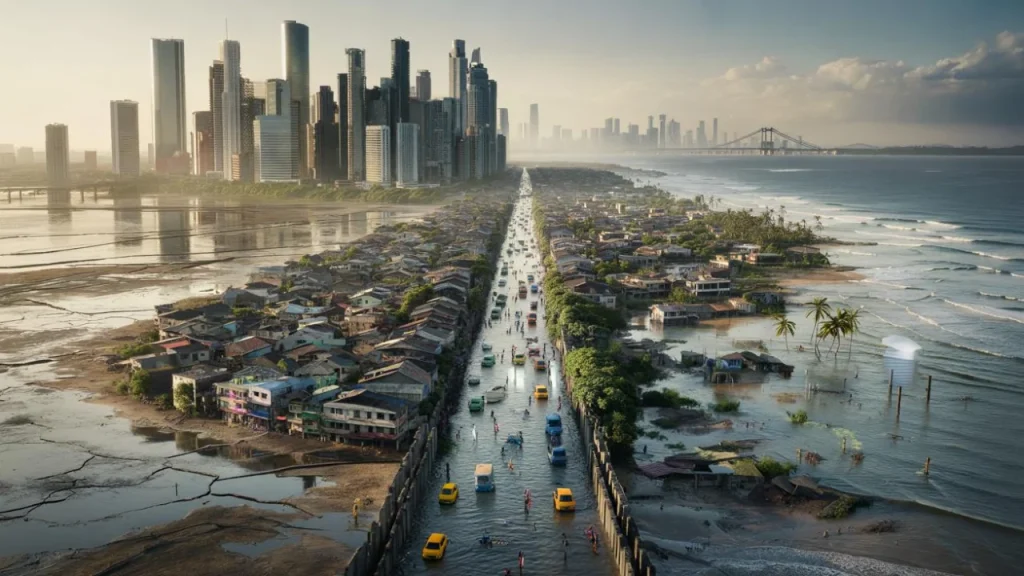

Maria Santos remembers when her grandmother’s house in Jakarta sat comfortably above the street level. Today, that same house requires sandbags during every rainy season, and the front steps disappear completely when high tide meets heavy rain. What her family thought was just “bad weather getting worse” turned out to be something far more permanent: their entire neighborhood has been slowly sinking into the earth.

Maria’s story isn’t unique. Across the globe, millions of people are discovering that the ground beneath their feet isn’t as solid as they once believed. Major cities sinking has become one of the most urgent yet invisible crises of our time, affecting urban areas that house nearly a fifth of the world’s population.
The numbers are staggering, but the human impact is what makes this crisis so immediate and personal for families like Maria’s.

The silent emergency happening beneath our feet
Whole megacities are quietly slipping downward, millimeter by millimeter, while seas rise in the opposite direction. The process moves slowly enough that residents can ignore it day to day, yet fast enough to completely redraw coastlines within a single human lifetime.
Recent research published in Nature Sustainability analyzed 48 major coastal cities showing clear signs of subsidence – the gradual sinking of land. These cities sinking represent home to roughly 635 million people, making this a crisis that touches nearly every continent.

“What we’re seeing is unprecedented in human history,” explains Dr. Sarah Chen, a geologist who studies urban subsidence. “Cities that took centuries to build are literally disappearing into the ground faster than we can adapt to the changes.”
The causes behind cities sinking vary, but they all stem from human activity. Massive groundwater pumping to supply growing populations removes the water that once supported underground soil layers. Heavy construction projects compress the earth beneath. Oil and gas extraction creates underground voids that eventually collapse.

Using satellite radar data spanning decades, researchers measured exactly how quickly different city districts are dropping. The measurements might sound small at first – just a few millimeters per year – but they accumulate into decimeters over decades, enough to completely erase coastal defenses and flood entire neighborhoods.
Six cities racing against time
Among the cities studied, several stand out for both their sinking speed and the massive populations at risk. Here’s what the data reveals:
| City | Sinking Rate (mm/year) | Population at Risk | Primary Cause |
| Jakarta, Indonesia | Up to 26 | 10.7 million | Groundwater pumping |
| Ahmedabad, India | Up to 23 | 8.3 million | Industrial extraction |
| Istanbul, Turkey | Up to 19 | 15.5 million | Construction weight |
| Houston, Texas | Up to 17 | 7.1 million | Oil/gas extraction |
| Lagos, Nigeria | Up to 17 | 15.3 million | Coastal development |
| Manila, Philippines | Up to 17 | 13.9 million | Groundwater depletion |
These annual rates might seem tiny, but imagine stacking a coin under your house every single year. Eventually, entire neighborhoods end up below sea level during high tides or storms.
Jakarta has become the poster child for cities sinking. Built on soft coastal sediments and heavily dependent on groundwater, Indonesia’s capital has been dropping for decades. Some districts have sunk several meters, forcing the government to make an unprecedented decision: they’re moving the entire capital city to Borneo.
“When a government decides to abandon a capital city of 10 million people, you know the problem has passed the point of normal engineering solutions,” notes urban planner Dr. Michael Rodriguez.
What this means for millions of people
The human cost of cities sinking goes far beyond flooded basements. Families face impossible choices between staying in homes that flood regularly or abandoning neighborhoods where their families have lived for generations.
Infrastructure bears the brunt of the damage. Roads crack and buckle as different sections sink at different rates. Subway tunnels flood more frequently. Airports struggle with runways that no longer drain properly. Water treatment plants designed for specific elevations find themselves below the water table.
The economic impact ripples through entire regions:
- Property values plummet in affected areas
- Insurance companies refuse to cover flood-prone districts
- Businesses relocate away from sinking commercial zones
- Tourism drops as coastal attractions become inaccessible
- Agricultural land becomes too salty for farming
But perhaps most troubling is how cities sinking disproportionately affects the world’s poorest residents. Wealthy families can afford to move to higher ground or install pumping systems. Low-income communities often have no choice but to stay and adapt as best they can.
“We’re creating a new kind of climate refugee,” explains Dr. Rodriguez. “People who aren’t fleeing storms or drought, but literally watching their neighborhoods disappear beneath the waves.”
The race for solutions
Some cities are fighting back with engineering marvels. Venice has spent billions on movable flood barriers. Miami Beach pumps millions of gallons of seawater away from streets during high tides. The Netherlands has pioneered floating neighborhoods that rise with flood waters.
However, these solutions work best for gradual sea level rise. When the land itself is sinking rapidly, the engineering challenges multiply exponentially.
A few cities have found success slowing subsidence by restricting groundwater pumping and switching to alternative water sources. Tokyo managed to reduce its sinking rate dramatically after implementing strict groundwater regulations in the 1970s.
“The key is acting before the damage becomes irreversible,” says Dr. Chen. “Once certain soil layers compress, they never bounce back. The subsidence becomes permanent.”
For cities where the sinking has advanced too far, managed retreat becomes the only realistic option. This means gradually relocating communities, businesses, and infrastructure to higher ground while the process is still manageable.
The challenge isn’t just technical – it’s deeply human. How do you convince someone to leave a home their family has occupied for generations? How do you rebuild the social fabric of communities that have existed in specific places for centuries?
FAQs
How fast are cities actually sinking?
Most affected cities sink between 10-25 millimeters per year, which adds up to several feet over decades.
Can cities stop sinking once it starts?
Some types of subsidence can be slowed by stopping groundwater pumping, but soil compaction is often permanent.
Which cities are at highest risk?
Coastal megacities built on soft sediments with heavy groundwater use face the greatest danger, particularly in Asia and Africa.
How do scientists measure land subsidence?
Satellite radar technology can detect ground movement with millimeter precision over large areas.
Is this connected to climate change?
While rising seas worsen the problem, most subsidence comes from human activities like groundwater pumping and heavy construction.
What can residents do if their city is sinking?
Stay informed about local subsidence rates, support water conservation efforts, and consider long-term relocation planning for severely affected areas.