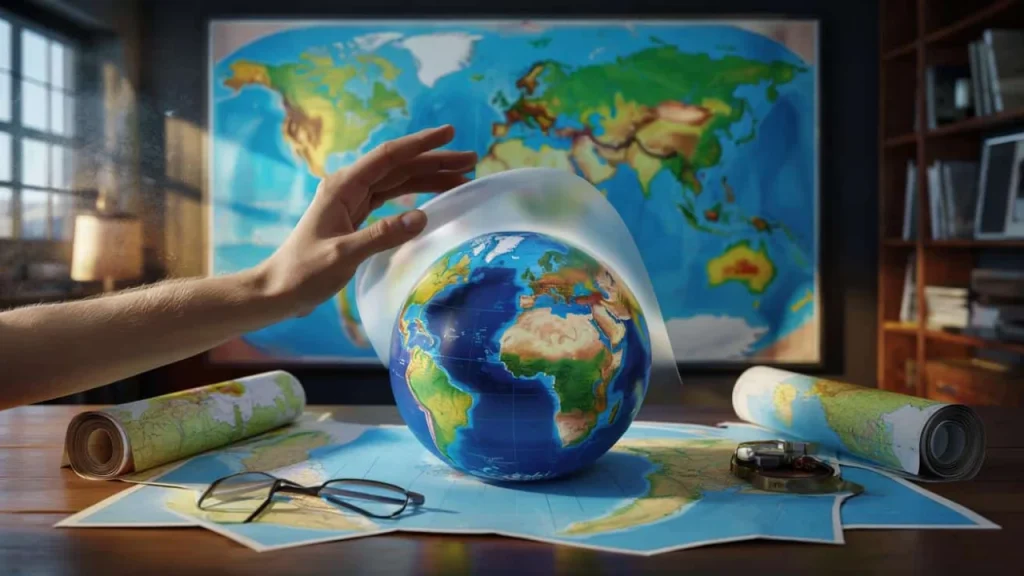

My geography teacher held up a globe and asked us to guess which was bigger: Greenland or Africa. Half the class pointed to Greenland. She smiled knowingly and spun the globe slowly. “Look again,” she said. Africa suddenly looked enormous – a sprawling continent that could swallow Greenland whole. We’d been fooled by every flat map we’d ever seen.

That moment stuck with me for years. How could something so basic be so wrong? It turns out millions of us carry this same geographic misconception, courtesy of maps that have been quietly lying to us for centuries.
Every time you pull up Google Maps or glance at a world map in a classroom, you’re seeing one of geography’s most persistent illusions. Greenland appears massive – sometimes looking as large as entire continents. But this visual trick has nothing to do with reality and everything to do with the mathematical challenges of flattening our round planet.

The Shocking Truth About Greenland’s Real Size
Here’s what your maps won’t tell you: Greenland covers about 2.1 million square kilometers, making it the world’s largest island. Sounds impressive, right? But when you compare it to what maps suggest, the numbers are startling.
Africa spans roughly 30.3 million square kilometers. That means Greenland could fit inside Africa about 14 times over. Yet on most flat maps, they look roughly the same size. This greenland map distortion has fooled generations of students, travelers, and even educated adults.

“I’ve had university students tell me they thought Greenland was bigger than Australia,” says Dr. Sarah Martinez, a geography professor at Northwestern University. “The visual impact of these distorted maps is incredibly powerful.”
The problem isn’t limited to Greenland. Antarctica looks like a massive ice continent stretching across the bottom of most maps, when it’s actually smaller than South America. Russia appears to dominate the northern hemisphere, but much of that apparent size comes from map distortion rather than actual landmass.

Why Every Flat Map Lies to You
Imagine trying to wrap a basketball with a flat piece of paper. Impossible, right? You’d have to stretch, tear, or fold the paper to make it fit. Mapmakers face the exact same challenge when they try to show our spherical Earth on flat surfaces.
This fundamental problem means every flat map must distort something – whether it’s size, shape, distance, or direction. There’s simply no way around it. The mathematics of converting a 3D sphere to a 2D surface guarantees that something will be sacrificed.

The most common world maps use the Mercator projection, created by Flemish cartographer Gerardus Mercator in 1569. His goal wasn’t to create accurate classroom posters – he was trying to help sailors navigate the open seas.
| Location | Actual Size (sq km) | How It Appears on Mercator Maps |
|---|---|---|
| Greenland | 2.1 million | Appears similar to Africa |
| Africa | 30.3 million | Appears smaller than it should |
| Antarctica | 14 million | Appears largest of all continents |
| Russia | 17.1 million | Appears to dwarf other countries |
The 16th Century Decision That Still Shapes Your Phone
Mercator’s projection solved a crucial problem for sailors: it allowed them to plot straight-line courses using a compass. On his maps, if you drew a straight line between two points, you could follow that exact compass bearing across the ocean.
But this navigation advantage came at a steep cost. To keep compass directions accurate, Mercator had to increasingly stretch areas as they moved toward the poles. The distortion becomes extreme in the Arctic and Antarctic regions.
“Mercator never intended his projection for general geography education,” explains cartographer James Wilson. “It was a specialized tool for maritime navigation, but somehow it became the default way we show the world.”
The projection’s popularity exploded during the colonial era, partly because it made European countries appear larger and more prominent. This wasn’t necessarily intentional, but it reinforced certain worldviews about global importance and power.
Today, digital mapping services like Google Maps still use Mercator-based projections for zoom-in views, though they often switch to globe views for broader perspectives.
How This Geographic Illusion Affects Your Worldview
These map distortions aren’t just academic curiosities – they shape how we think about our planet and its places. When Greenland looks continental in size, it seems more geopolitically important than it actually is. When Africa appears modest, its true massive scale and significance get understated.
Students consistently underestimate the size of tropical regions while overestimating polar areas. This skews understanding of population distributions, climate patterns, and economic relationships.
- Travel planning becomes misleading when distances appear shorter or longer than reality
- Climate discussions lose context when tropical regions seem smaller than they are
- Economic and political analysis suffers from size misperceptions
- Cultural awareness decreases when entire continents appear diminished
“These visual biases run deeper than we realize,” notes geography education researcher Dr. Patricia Chen. “Students who grow up with distorted maps carry those mental images into adulthood.”
The good news? Alternative map projections exist that show more accurate sizes. The Gall-Peters projection, for instance, preserves area relationships while distorting shapes. The Robinson projection offers a middle ground that balances various distortions.
Breaking Free From the Geographic Illusion
Modern technology offers solutions our ancestors couldn’t imagine. Interactive globes, satellite imagery, and digital tools can show Earth’s true proportions without the constraints of flat paper.
Many educators now use multiple projections to teach geography, showing students how different maps serve different purposes. Some online tools even let you drag countries around to see their true comparative sizes.
“The key is understanding that every map makes choices about what to preserve and what to distort,” explains cartographer Michael Torres. “Once you know that, you can read maps more critically.”
The next time you see Greenland looming large on a world map, remember: it’s not trying to deceive you. It’s just mathematics at work, stretching reality to fit the constraints of flat surfaces. But now you know the truth behind the illusion.
FAQs
Why does Greenland look so big on Google Maps?
Google Maps uses the Mercator projection, which increasingly distorts sizes as you move toward the poles, making Greenland appear much larger than its actual size.
How much smaller is Greenland compared to Africa?
Greenland is about 14 times smaller than Africa, covering 2.1 million square kilometers compared to Africa’s 30.3 million square kilometers.
Are there maps that show accurate sizes?
Yes, equal-area projections like the Gall-Peters projection preserve accurate size relationships, though they distort shapes instead.
Why don’t we use more accurate maps in schools?
The Mercator projection became standard due to its historical importance for navigation and its familiar appearance, though this is slowly changing in education.
Does this distortion affect other countries too?
Absolutely – Russia, Canada, and Antarctica all appear much larger than they actually are, while equatorial regions like Africa appear smaller.
Is this map distortion intentional?
No, it’s a mathematical necessity when flattening a sphere onto a flat surface. Every flat map must distort something – size, shape, distance, or direction.