

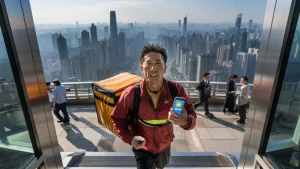
Wang Chen checks his phone one more time before stepping into the gleaming lobby of the Shanghai World Financial Center. His thermal bag contains four lunch orders, and his app shows he has exactly eight minutes to reach the 85th floor. The elevator ride alone will take three of those minutes.

This isn’t your typical food delivery story. Wang doesn’t ride a scooter through busy streets or navigate crowded sidewalks. His entire workday happens inside a single building, racing between floors in what might be the world’s most vertical commute.
He’s part of China’s newest workforce: skyscraper food delivery specialists who spend their days in elevators, making lunch possible for thousands of office workers stacked high above the city streets.
When Cities Grow Up Instead of Out
China’s megacities have run out of room to spread sideways, so they’ve been building up. Way up. Cities like Shenzhen, Shanghai, and Guangzhou now have financial districts where a single city block contains more office workers than entire suburban towns.
The numbers tell the story. Shenzhen alone has over 400 buildings taller than 150 meters. Shanghai’s Lujiazui district packs roughly 300,000 office workers into just 1.7 square kilometers. When lunch time hits, these vertical cities create a logistics nightmare that traditional food delivery simply can’t handle.

“We realized that sending a regular delivery driver up to the 90th floor was completely inefficient,” explains Li Ming, a logistics coordinator for one of China’s major food delivery platforms. “By the time they got back down, they’d missed five other deliveries on the street level.”
That’s where skyscraper food delivery specialists come in. These workers have turned the inside of buildings into their highways, mastering the art of vertical logistics that keeps China’s sky-high workforce fed.

The Numbers Behind the New Job
Here’s what makes skyscraper food delivery so different from regular delivery work:
| Traditional Delivery | Skyscraper Delivery |
|---|---|
| 15-20 deliveries per shift | 30-40 deliveries per shift |
| Average travel time: 8-12 minutes | Average travel time: 3-5 minutes |
| Main challenge: Traffic | Main challenge: Elevator wait times |
| Equipment: Scooter, thermal bag | Equipment: Building access cards, multiple thermal bags |
The specialized knowledge these workers develop is remarkable:

- Which elevator banks serve which floors fastest
- Hidden service elevators that skip crowded lobbies
- Building schedules and when elevators get maintenance
- Security guard shifts and access protocols
- Floor layouts and the quickest routes to different office suites
“I know the Ping An Finance Centre better than my own apartment building,” says Zhang Wei, who has been doing skyscraper food delivery for two years. “I can tell you which elevator will be available on the 67th floor at 12:23 PM on a Tuesday.”
Some delivery specialists work exclusively in single buildings. Others cover building clusters, but they all share one thing: they’ve mastered the vertical city in ways that would make regular delivery drivers dizzy just thinking about it.
How Your Lunch Actually Gets to the 95th Floor
The system that’s emerged is surprisingly sophisticated. It typically works in three stages:
Stage 1: Street Level Pickup
Regular delivery drivers collect orders from restaurants and transport them to the building. They park in designated zones and hand off the orders to building specialists.
Stage 2: Vertical Transport
Skyscraper delivery specialists take over, using their knowledge of building systems to get food to the right floors quickly. Many carry special access cards and know which elevators to avoid during peak hours.
Stage 3: Final Delivery
The specialist navigates office layouts, deals with reception desks, and ensures the food reaches the customer while still hot.
This system has cut average delivery times from 25-30 minutes to 15-20 minutes in many high-rise districts. More importantly, it’s made food delivery economically viable in China’s vertical cities.
“Before this system existed, many restaurants just couldn’t deliver to upper floors,” explains restaurant owner Chen Lu. “The time and cost didn’t make sense. Now we serve customers on the 80th floor as easily as those on the 8th.”
The Human Cost of Feeding the Sky
But this efficiency comes with real human challenges. Skyscraper food delivery workers face unique physical and mental pressures that street-level delivery doesn’t involve.
The constant elevator rides cause motion sickness for some workers. Others develop knee problems from the repetitive standing and walking on hard floors. The psychological pressure is intense too – being trapped in a building during busy periods, with orders backing up and customers calling, creates stress that outdoor delivery workers don’t experience.
“Sometimes I feel like a hamster in a wheel,” admits delivery specialist Liu Xiao. “Up and down, up and down, all day long. At least regular delivery drivers get to see the sky.”
The pay structure has adapted to these challenges. Skyscraper delivery specialists often earn 20-30% more than regular delivery workers, with bonuses for handling the highest floors or most challenging buildings.
Some buildings have started providing dedicated spaces for delivery workers – rest areas, water stations, and even lockers for personal belongings. It’s a recognition that these workers have become essential infrastructure for China’s vertical cities.
What This Means for the Future
This isn’t just a quirky Chinese phenomenon. As cities worldwide grow denser and build taller, the logistics of skyscraper food delivery are becoming relevant everywhere.
New York, London, and Dubai are all watching China’s vertical delivery systems. Some Manhattan buildings have started experimenting with dedicated delivery personnel during lunch rushes. The lessons learned in Shenzhen’s 100-story towers might soon apply to skyscrapers around the world.
“We’re essentially creating the infrastructure for how people will eat in future cities,” says urban planning expert Dr. Sarah Chen. “China is just ahead of the curve because they built so many tall buildings so quickly.”
Technology is evolving too. Some buildings are testing pneumatic tube systems for small deliveries. Others are experimenting with drone delivery to specific floors, though regulations and safety concerns keep these systems limited for now.
The workers themselves are adapting and specializing further. Some focus on medical deliveries to high-rise clinics. Others specialize in late-night deliveries to 24-hour offices. The vertical economy is creating micro-specializations that didn’t exist five years ago.
FAQs
How much do skyscraper food delivery workers earn?
They typically earn 20-30% more than regular delivery drivers, often making 8,000-12,000 yuan ($1,100-1,700) per month in major cities.
Do these workers need special training?
Most learn on the job, but some delivery companies now offer building-specific orientation programs covering elevator systems and security protocols.
What happens if elevators break down?
Most specialists know service elevator locations and emergency procedures. Some buildings have backup systems, though major elevator outages can shut down delivery service entirely.
Are there health risks to this job?
Yes, including motion sickness, joint problems from constant standing, and stress from time pressure in confined spaces.
Could robots replace these workers?
Some buildings are testing delivery robots, but they’re limited by elevator capacity and can’t handle complex office layouts or security requirements yet.
How fast can they deliver to the highest floors?
Experienced specialists can reach the 100th floor and back in under 10 minutes, including delivery time, if elevators cooperate.